 5.0
5.0
 4.9
4.9
 HubSpot
 4.9
4.9

A founder opens ChatGPT and types the question her own buyers ask: “Who are the best managed IT providers in Southern Ontario?” The answer lists five companies. Three are direct competitors. One is a firm she has never heard of. Her company, which has been in business for twelve years and ranks on the first page of Google for that exact phrase, is not mentioned.
She tries Gemini. Then Perplexity. Then Claude. The names change slightly, but the pattern holds. Her competitors keep showing up. She does not.
This is now one of the most common conversations we have with B2B leaders at Parkyd Digital, and it is worth taking seriously. A growing share of buyers begin research by asking an AI platform for a shortlist rather than scanning ten blue links. When an AI platform builds that shortlist without you, you are not losing a click. You are being left out of the consideration set before the buyer ever visits a website.
The good news is that this is rarely random. AI platforms recommend companies for reasons that can be identified, measured and improved. This article explains those reasons and gives you a practical framework to close the gap.
DIRECT ANSWER
AI platforms recommend competitors instead of you when external evidence about your business is weaker than theirs. ChatGPT, Gemini, Claude and Perplexity draw on your website, search results, third-party mentions, reviews, directories and authoritative publications. If competitors are described more clearly and cited more often across those sources, AI systems treat them as the safer recommendation.
How Do AI Platforms Decide Which Companies to Recommend?
There is no single ranking algorithm behind AI recommendations. Each platform uses its own combination of model training data, live web retrieval and source selection, and those systems change frequently. What we can say with confidence is that the recommendations are shaped by evidence, and that evidence comes from a fairly consistent set of places.
When an AI platform answers a “who should I work with” question, it is usually doing some version of the following: interpreting what the user wants, retrieving or recalling information about companies associated with that need, weighing how credible and consistent that information is, and then composing an answer. Platforms with live search (ChatGPT with search, Gemini, Perplexity, Copilot) lean heavily on what is currently indexed on the web. Platforms answering from training data lean on what was written about you across many sources over time.
Across both modes, the signals that appear to influence which companies get named include:
- Website relevance: whether your site clearly describes the service, the market and the problems you solve.
- Brand and entity understanding: whether the system can connect your company name to a specific category, location and set of offerings.
- Third-party mentions: how often other websites refer to you, and in what context.
- Authoritative citations: mentions on sources the platform already treats as reliable, such as industry publications, associations and well-established directories.
- Backlinks: links remain a strong corroboration signal for the search indexes that many AI platforms draw from.
- Reviews: volume, recency and consistency across Google, Clutch, G2, Trustpilot and sector-specific review sites.
- Industry directories and listicles: inclusion in “best of” and “top providers” pages that AI systems frequently pull from when asked for recommendations.
- Topical authority: depth of content on the subject, not just one service page.
- Structured content and structured data: clear headings, direct answers, tables and schema markup that make your pages easy to parse.
- Brand consistency: the same name, description, address and category across every public listing.
- Traditional search visibility: platforms that retrieve from Google or Bing can only cite what those indexes surface.
- Freshness and corroboration: recently updated information that is confirmed by more than one source.
Think of it as a weight-of-evidence problem. No single signal decides the outcome. The company with the most consistent, independently corroborated story across these sources tends to be the one the AI platform names.
7 Reasons AI Platforms Recommend Your Competitors Instead of You
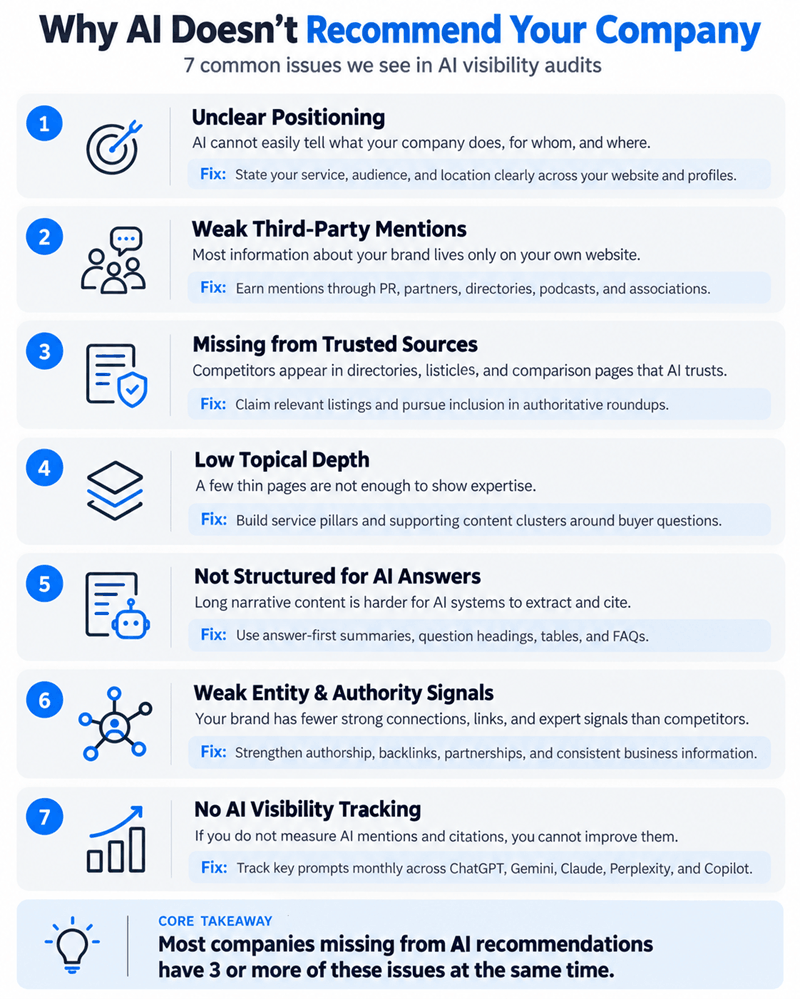
Where Do AI Platforms Get Information About Your Business
The reasons below come up repeatedly in the AI visibility audits we run. Most companies that are missing from AI recommendations have three or more of these problems at the same time.
1. AI systems do not clearly understand what your company is known for
What it means: Your website describes you as a “full-service growth partner” or a “technology solutions company.” Humans can decode that with context. An AI system cannot connect a vague label to a specific buyer question.
Why competitors benefit: Competitors who state plainly that they are “a HubSpot implementation agency for manufacturers in Ontario” give the model an exact match for the query. Precision wins over positioning language.
How to identify it: Ask ChatGPT, Gemini and Perplexity “What does [your company] do?” If the answers are vague, wrong or borrowed from an outdated description, your entity is poorly defined.
What to improve: Rewrite your homepage and About page so the first hundred words state what you do, for whom, and where. Use the same description on LinkedIn, Google Business Profile, Crunchbase and every directory. Add Organization schema with sameAs links to those profiles.
2. Your competitors have stronger third-party brand mentions
What it means: Your site may be excellent, but almost everything written about you lives on your own domain. AI systems give more weight to what others say than to what you say about yourself.
Why competitors benefit: A competitor mentioned in trade publications, partner pages, podcast show notes, association member lists and local business journals has dozens of independent sources agreeing on who they are. That consensus is exactly what an AI platform looks for.
How to identify it: Search your brand name in quotation marks and exclude your own domain. Count the meaningful mentions from the past 12 months. Do the same for two competitors.
What to improve: Build a mention program: guest contributions, partner co-marketing, association involvement, local press, podcast appearances and expert commentary. The goal is unlinked and linked mentions on sites that already have authority in your category.
3. Competitors appear on authoritative sources AI systems trust
What it means: When a user asks for the “best” providers, many AI platforms retrieve existing “best of” lists, comparison pages and directories and synthesize from them. If you are not on those pages, you are not in the pool of candidates.
Why competitors benefit: Competitors listed on Clutch, G2, Capterra, DesignRush, industry association directories and regional “top agencies” roundups are being handed to the AI platform pre-vetted.
How to identify it: Run your core query in Perplexity and check the cited sources. Then search Google for “best [category] [region]” and note which listicles rank. Check whether you appear on any of them.
What to improve: Claim and complete every relevant directory profile. Pitch inclusion in the listicles that rank. Where no good list exists, publish your own well-researched comparison page and promote it so it earns links.
4. Your website lacks topical depth and supporting content
What it means: One service page, a thin About page and a blog that has not been updated in a year do not establish authority on a subject. AI systems look for evidence that you cover the topic in depth.
Why competitors benefit: A competitor with twenty interlinked articles covering the problem, the process, pricing considerations, common mistakes and industry-specific applications looks like a specialist. Specialists get recommended.
How to identify it: List every page on your site that addresses your core service. Compare that list with a competitor’s. Gaps are usually obvious within minutes.
What to improve: Build a topic cluster: one pillar page per core service, supported by articles that answer the specific questions buyers ask at each stage. Link them together deliberately.
5. Your content is not structured for direct AI answers
What it means: AI platforms extract passages, not whole pages. Long, narrative paragraphs with no clear answer make extraction difficult. Pages that bury the answer under three paragraphs of preamble rarely get cited.
Why competitors benefit: Competitors who use question-based headings, lead each section with a direct answer, and include definitions, tables and FAQs give the model clean, quotable blocks.
How to identify it: Open your most important page and ask: if an AI system read only the first two sentences under each heading, would it have the answer? If not, the page is written for browsing, not extraction.
What to improve: Restructure key pages with answer-first paragraphs, descriptive H2 and H3 headings phrased as questions, short definitions, comparison tables and an FAQ block with concise answers.
6. Your competitors have stronger entity and authority signals across the web
What it means: Entity signals are the connections between your brand and the people, places, topics and organizations around it. Authority signals are the links, citations and references that confirm you are credible. Competitors often win because theirs are deeper, not because their service is better.
Why competitors benefit: A competitor whose founders publish under their own names, whose company has a complete Wikidata or Crunchbase record, whose partners link to them and whose work is referenced in case studies has a richer, more connected entity profile.
How to identify it: Check your backlink profile against two competitors using any major SEO tool. Look at referring domain count, topical relevance of linking sites and whether your leadership is cited anywhere as experts.
What to improve: Invest in named authorship with real credentials, pursue links from relevant and reputable sites, document partnerships publicly, and keep your NAP and category information identical everywhere. Google’s own guidance on helpful, reliable, people-first content and its Search Quality Rater Guidelines describe the Experience, Expertise, Authoritativeness and Trustworthiness signals that matter here.
7. You are not actively measuring and improving AI visibility
What it means: Most companies have never run their own buyer queries across AI platforms, let alone tracked the results over time. You cannot improve what you have not measured, and AI answers change week to week.
Why competitors benefit: Competitors who track their AI mention rate, monitor which sources get cited and adjust their content and PR accordingly compound their advantage. Early movers also benefit from being cited in content that is later used to train or ground newer models.
How to identify it: If you do not have a list of the 20 to 50 prompts your buyers would ask, with a monthly record of which brands each platform names, you are not measuring.
What to improve: Set up a prompt set, run it monthly across ChatGPT, Gemini, Claude, Perplexity and Copilot, record mentions and citations, and tie the work back to referral traffic and pipeline. The measurement section below covers this in detail.
Ranking on Google Does Not Automatically Mean AI Platforms Will Recommend You
Many business owners assume that a page-one Google ranking should carry over into AI answers. It helps, but it is not sufficient, and the reasons matter.
Traditional SEO rankings are about one page competing for one query in one index. Your page ranks because of its relevance, links and technical quality relative to other pages.
AI citations happen when a platform retrieves a specific passage and references it in a generated answer. The page needs to be retrievable, but it also needs to contain a clean, extractable statement that answers the question.
AI recommendations are about entities, not pages. When a platform names a company, it is drawing on everything it can find or recall about that company. A single high-ranking page cannot substitute for consistent corroboration across the wider web.
Generative search visibility is the combination of all three: appearing in AI Overviews and other AI features, being cited in AI answers and being named in AI recommendations across platforms.
SEO remains foundational. Platforms that use Google or Bing retrieval can only work with what those indexes surface, so an invisible site stays invisible. But a company can rank number one for its service keyword and still be absent from AI recommendations because its entity profile is thin, its third-party footprint is small or its content is not written in a form that AI systems can extract and trust. Treat rankings as the floor, not the finish line.
Where Do AI Platforms Get Information About Your Business?
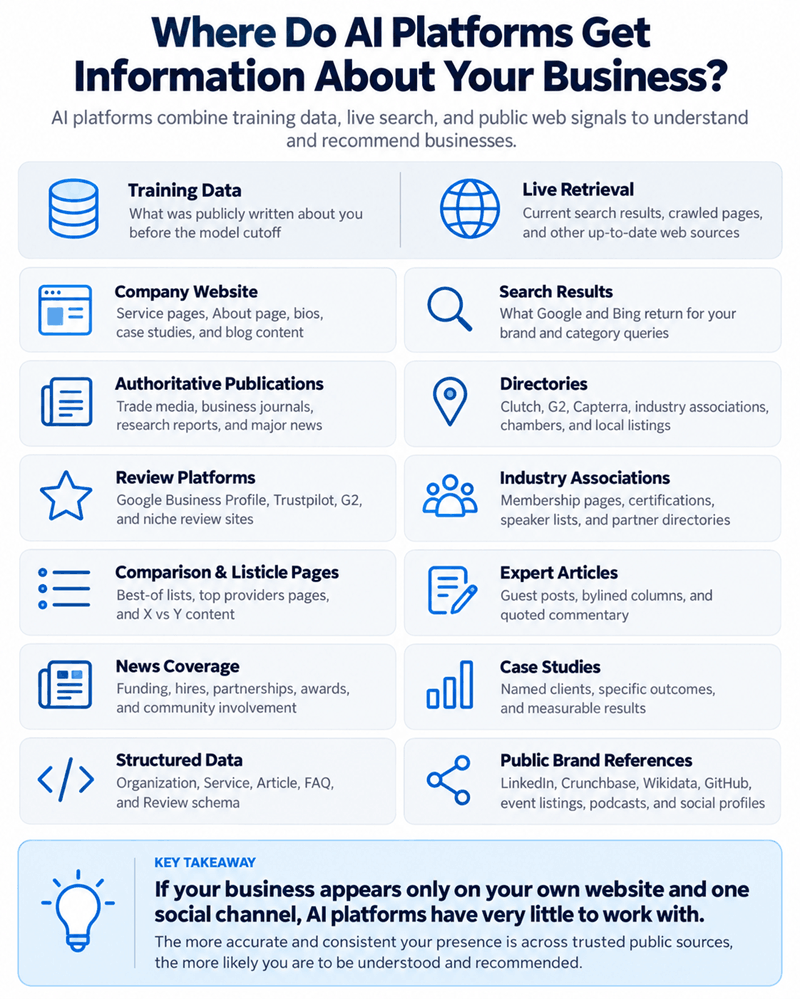
Different AI platforms rely on different sources depending on how they are built and what the query asks for. A platform answering from training data draws on what was publicly written about you before its cutoff. A platform with live retrieval pulls from current search results and the pages behind them, often through its own crawler (OpenAI documents its OAI-SearchBot and GPTBot crawlers, for example). Most commercial platforms now combine both. The practical sources include:
- Your company website: service pages, About page, team bios, case studies and blog content.
- Search results: what Google and Bing return for your brand and your category terms.
- Authoritative publications: trade media, business journals, research reports and major news outlets.
- Directories: Clutch, G2, Capterra, industry association member lists, chambers of commerce, regional business directories.
- Review platforms: Google Business Profile, Trustpilot, G2, industry-specific review sites.
- Industry associations: membership pages, certification listings and speaker lists.
- Comparison and listicle pages: “best of,” “top providers” and “X vs Y” content, whether published by third parties or by you.
- Expert articles: guest posts, bylined columns and quoted commentary that connect named people to your brand.
- News coverage: funding, hires, partnerships, awards and community involvement.
- Case studies: documented outcomes, especially when the client is named and the result is specific.
- Structured data: Organization, Service, Article, FAQPage and Review schema that state facts about you in machine-readable form.
- Public brand references: LinkedIn, Crunchbase, Wikidata, GitHub, podcast directories, event listings and social profiles.
The implication is simple. If your presence is concentrated on your own website and one social channel, the AI platform has very little to work with. Spreading accurate, consistent information across many of these sources is the single most effective thing most B2B companies can do.
Why Third-Party Mentions Matter for AI Recommendations
AI platforms are built to be cautious about self-promotion. The principle at work is independent corroboration: a claim becomes more credible when sources that do not benefit from it agree.
Here is the difference in practice. A company writes on its homepage that it is “a leading cybersecurity provider for mid-sized manufacturers.” That is a self-claim. Every company says something similar, so it carries little weight on its own.
Now imagine that the same company is listed in a manufacturing association’s vendor directory under cybersecurity, is named in a regional business journal’s coverage of a ransomware incident, appears in a Clutch list of cybersecurity firms with thirty verified reviews, has its CISO quoted in an industry publication, and is referenced in two client case studies published on the clients’ own sites. Five independent sources now associate the company with the same category and audience.
When an AI platform assembles a recommendation, the second company has evidence. The first company has a statement. This is why building third-party mentions, even unlinked ones, is central to AEO and GEO work and why it deserves a budget alongside on-site content.
How to Find Out Why Your Competitors Are Being Recommended
Before investing in fixes, run a structured comparison. Pick your two most frequently recommended competitors and work through the signals below. Record what you find rather than estimating. The goal is to see where the gap is widest so you can prioritize.
Signal | Typical gap when your brand is missing | What recommended competitors usually have | What to check | Priority |
AI mentions | Named in few or none of your core buyer prompts, or only when the prompt includes your brand name. | Named consistently across several platforms for unbranded category and location prompts. | Run 20 to 50 buyer prompts across ChatGPT, Gemini, Claude, Perplexity and Copilot. Count how often each brand is named. | High |
AI citation frequency | Your domain is rarely or never shown as a source, even when your page ranks for the query. | Their pages are cited as sources for category questions, often the same two or three pages repeatedly. | In platforms that show sources (Perplexity, ChatGPT search, Gemini), count how often each domain is cited for category queries. | High |
Branded search presence | No knowledge panel, thin or inconsistent top results, outdated descriptions on third-party sites. | Knowledge panel, sitelinks, reviews and a consistent description across the first page of branded results. | Search each brand name. Check the knowledge panel, sitelinks, reviews and whether the top results are consistent and accurate. | Medium |
Third-party mentions | Almost everything written about you lives on your own site and social profiles. | Mentioned on partner pages, trade publications, association lists, podcasts and local business media. | Search “brand name” minus the brand’s own domain. Note the number, quality and recency of meaningful mentions. | High |
Authoritative backlinks | Low referring-domain count, links mostly from directories or unrelated sites. | Links from relevant industry sites, publications and partners, plus references to named experts. | Compare referring domains, topical relevance and the authority of linking sites using an SEO tool. | High |
Industry directory presence | Unclaimed or half-complete profiles, wrong category, few or no reviews. | Complete profiles on Clutch, G2, Capterra and association directories with current reviews. | Check Clutch, G2, Capterra, association directories and regional listings. Note completeness and review counts. | Medium |
Reviews | Few reviews, old reviews, or reviews concentrated on one platform. | Steady flow of recent reviews across Google and category-specific platforms. | Compare volume, average rating, recency and distribution across Google and category-specific platforms. | Medium |
Topical coverage | One service page and a handful of unrelated blog posts. | A pillar page per service with interlinked supporting articles covering buyer questions in depth. | Count pages that cover the core service and its related questions. Note depth and interlinking. | High |
Comparison / listicle inclusion | Absent from “best of” roundups and comparison pages; no comparison content of your own. | Listed in the roundups that rank, and publishing their own honest “X vs Y” pages. | Search “best [category] [region]” and “[competitor] vs” queries. Record which lists include each brand. | High |
Structured data | No schema, or only basic WebPage markup with errors. | Valid Organization, Service, Article and FAQPage markup on the pages that matter. | Use a schema validator on the homepage, service pages and blog. Check for Organization, Service, Article and FAQPage markup. | Medium |
Expert attribution | Content published under a generic “Admin” or company byline; no author pages. | Named experts with author pages, LinkedIn profiles and external bylines or quotes. | Check whether named leaders are quoted, bylined or profiled on external sites, and whether author pages exist on-site. | Medium |
Content freshness | Key pages untouched for a year or more; blog cadence has stalled. | Core pages updated within the last six months and a regular publishing rhythm. | Compare last-updated dates on key pages and the publishing cadence of the blog over the past 12 months. | Medium |
Entity consistency | Different descriptions, categories or addresses across the website, Google Business Profile, LinkedIn and directories. | The same name, description, category and contact details everywhere. | Compare company name, description, category, address and phone across the website, Google Business Profile, LinkedIn and directories. | High |
Most companies finish this exercise with a clear picture. The competitor is usually winning on three to five signals, and those signals point directly to the work that needs to happen.
How to Improve Your Visibility Across AI Platforms
Improving AI visibility is a sequence, not a single tactic. The order below reflects what we have found works in practice: fix the foundation first, then build evidence, then measure. The 14 steps are grouped into three phases so you can plan them as quarters of work rather than one long list.
Phase 1: Foundation and Entity Clarity (Steps 1 to 3)
- Clarify brand and entity positioning. Write one plain-language description of what you do, for whom and where. Use it everywhere. Update your homepage, About page, LinkedIn, Google Business Profile and directory listings so they match.
- Build topic clusters. Create a pillar page for each core service and support it with articles that answer the specific questions buyers ask before, during and after a purchase decision.
- Create answer-first content. Lead every section with the answer, then explain. Use the formatting principles covered in the next section.
Phase 2: Authority and Third-Party Mentions (Steps 4 to 9)
- Earn third-party mentions. Target association directories, partner pages, trade publications, local business media and podcast appearances. Unlinked mentions on relevant sites still count as corroboration.
- Improve digital PR. Treat newsworthy moments (original data, hires, partnerships, community work) as opportunities to be written about by others.
- Publish original research and data. Surveys, benchmarks and documented observations give other sites a reason to cite you. This is covered in its own section below.
- Build comparison and decision-stage content. Publish honest “X vs Y” and “best options for” pages. AI platforms often retrieve these when asked for recommendations. We practise this ourselves with a set of agency comparison pages.
- Improve expert authorship. Attach real names, credentials and author pages to your content. Encourage your experts to contribute externally under the same name.
- Cite authoritative sources. Reference primary documentation and credible research in your own content. It signals rigour and connects your pages to trusted entities.
Phase 3: Technical SEO and Measurement (Steps 10 to 14)
- Strengthen internal linking. Link pillar pages, supporting articles, case studies and service pages so the relationship between topics is explicit.
- Implement relevant schema. Organization with sameAs, Service, Article with author, FAQPage and Review markup where appropriate. Validate after deployment. Our LLM optimization checklist covers the technical items in order.
- Improve traditional SEO authority. Keep pursuing relevant backlinks and technical health. Retrieval-based AI platforms depend on search indexes, and both Google and Bing’s webmaster guidelines still govern what those indexes surface.
- Update outdated content. Refresh statistics, examples and recommendations on your most important pages at least twice a year. Stale pages lose citations.
- Track AI visibility over time. Run your prompt set monthly and record the results. Adjust the plan based on which signals move.
Create Content AI Platforms Can Easily Understand and Cite
Extraction-friendly content is not a different kind of writing. It is clear writing with a structure that makes the key statements easy to locate. The following practices consistently help:
- Direct answers. State the answer in the first sentence or two under each heading, then expand.
- Question-based headings. Phrase H2 and H3 headings the way a buyer would ask the question.
- Definitions. When you introduce a term such as AEO or AI share of voice, define it in one clean sentence.
- Concise summaries. Add a short summary block near the top of long pages.
- Tables. Use tables for comparisons, criteria, steps and specifications. They are easy to parse and frequently reproduced in AI answers.
- Comparison sections. Explicit “A vs B” sections with consistent criteria.
- Statistics. Include specific figures where you have them, with a source. Never invent them.
- Source citations. Link to the primary documentation or research you relied on.
- FAQs. Add a FAQ block with 40 to 80 word answers that stand on their own.
- Expert quotes. Attribute insights to named people with relevant credentials.
- Clear entities. Name companies, products, locations and people explicitly rather than using pronouns or vague references.
- Descriptive headings. Avoid clever headings that hide the content. “How long does AEO take?” beats “Patience pays off.”
What does not help is repeating the target keyword in every paragraph. AI systems and modern search engines understand synonyms and context. Keyword stuffing makes content harder to read and less likely to be cited, not more. For a page-by-page walkthrough of these formatting rules, see our guide to getting cited by ChatGPT and Perplexity.
Build Original Information Worth Citing
This is the section most companies skip, and it is the one that separates brands that get cited from brands that get ignored. AI platforms and the publications they draw from need sources. If your content only restates what is already on the web, there is no reason for anyone to cite you instead of the original.
Original information includes:
- Research and surveys: a survey of 150 Ontario manufacturers about their IT priorities is citable. A summary of someone else’s survey is not.
- Benchmark data: aggregated, anonymized figures from your own client work, such as average conversion rates by industry or typical time-to-result for a service.
- Case studies: specific, documented outcomes with context on what was done and why it worked. Our own case studies follow this format: named client, what was done, what changed.
- Proprietary frameworks: a named process or model that explains how you approach a problem. Frameworks get referenced because they give writers a structure to borrow.
- Statistics you generated: counts, rates and trends from your own data, clearly described.
- Industry observations: patterns you see across many clients that an individual company would not notice.
At Parkyd Digital we hold ourselves to the same standard. The AI visibility audits we run across client accounts produce patterns, and publishing those patterns, with appropriate anonymization, is more valuable to readers and to our own citation profile than another rewrite of a Google documentation page.
We recommend every B2B company commit to publishing at least one piece of original research or benchmark data per year, and promoting it with the same effort as a product launch.
When original data is combined with clear structure and expert authorship, it becomes the content that listicle writers, journalists and AI platforms reach for first.
How Should You Measure AI Search Visibility?
There is no standardized industry metric for AI visibility yet, and tool vendors define terms differently. That does not prevent you from measuring consistently. Pick definitions, document them and track them the same way every month. Useful metrics include:
- AI Mention Rate: the percentage of your tracked prompts in which your brand is named, by platform.
- AI Citation Rate: the percentage of prompts in which your domain is cited as a source, in platforms that expose sources.
- AI Share of Voice: your mentions as a share of all brand mentions across the prompt set, compared with named competitors.
- Branded AI recommendations: how often your brand is positioned as a recommendation rather than a passing mention.
- Competitor recommendation frequency: the same measures for your two or three most relevant competitors.
- Referral traffic from AI platforms: sessions from chatgpt.com, perplexity.ai, gemini.google.com, copilot.microsoft.com and similar referrers in your analytics.
- Assisted conversions from AI search: leads and pipeline where an AI referral appears in the conversion path.
- Number of queries where the brand appears: the absolute count of prompts with a mention, which helps track growth as the prompt set expands.
Run the prompt set at a fixed cadence, ideally monthly, using fresh sessions so previous conversations do not bias the answers. Record the brands named, the sources cited and the position of your mention. Over three to six months the trend line tells you whether the work is paying off.
For definitions, formulas and a tracking template for each of these, see our guide to the GEO metrics to track.
How Long Does It Take to Improve AI Visibility?
It depends, and anyone who promises a specific timeline is guessing. The honest answer is that some signals move quickly and others take months, because they depend on third parties and on how often each AI platform refreshes its retrieval sources or its underlying model.
Factors that determine the timeline include:
- Current authority: a company with an established backlink profile and brand footprint starts closer to the finish line.
- Website quality: technical health, crawlability and clear structure allow improvements to be picked up faster.
- Competitive landscape: a niche with two credible competitors is easier to enter than one with twenty well-documented ones.
- Third-party visibility: directory listings and review profiles can be improved within weeks. Earning press and expert mentions takes longer.
- Crawl and indexing: updated pages need to be recrawled and reindexed before retrieval-based platforms can use them.
- Content improvements: restructuring existing pages shows results faster than building a cluster from scratch.
- PR and citation acquisition: the slowest and most valuable component, often measured in quarters.
In our experience, on-site and directory fixes often show up in retrieval-based platforms within weeks, while shifts in how a brand is described across all platforms tend to require several months of consistent effort. Treat the first 90 days as foundation work and expect the clearest gains in the six-to-twelve-month window.
SEO vs AEO vs GEO: What Actually Matters?
These three disciplines are often presented as competing. In practice they overlap heavily and reinforce one another. The term GEO comes from a 2023 research paper, GEO: Generative Engine Optimization, which tested which content changes most increased visibility in generative engine responses. You will also see the same discipline described as LLM SEO. Here is how the three differ:
| SEO | AEO (Answer Engine Optimization) | GEO (Generative Engine Optimization) |
Primary goal | Rank pages in search engine results | Be the source of the direct answer to a question | Be mentioned, cited and recommended in AI-generated responses |
Where visibility occurs | Google and Bing organic results | Featured snippets, People Also Ask, voice assistants, AI Overviews | ChatGPT, Gemini, Claude, Perplexity, Copilot and AI Overviews |
Main optimization focus | Keywords, technical health, backlinks, page relevance | Question-based structure, concise answers, FAQ and schema markup | Entity clarity, third-party corroboration, citable original content, cross-web consistency |
Typical outcome | Clicks from rankings | Position zero and zero-click visibility | Inclusion in AI shortlists and recommendations, AI referral traffic |
SEO builds the index presence that AEO and GEO depend on. AEO shapes content so it can be extracted. GEO extends that work to the wider web so AI platforms have corroborating evidence. A company that treats them as one connected program, rather than three separate budgets, gets better results from each.
Learn more about how we run the three as one program on our AI SEO, AEO and GEO services page.
Find Out Why AI Platforms Are Recommending Your Competitors Instead of Your Brand
Being left out of AI recommendations is a visibility problem with identifiable causes. The companies that show up are not necessarily better. They are better documented, better corroborated and better structured for the way AI platforms gather evidence.
If you want to know exactly where the gap is, an AI Visibility Audit from Parkyd Digital evaluates:
- AI recommendations: which brands each major platform names for your buyer queries.
- Citation gaps: which sources are cited for your category and whether you appear on them.
- Competitor visibility: how your two or three closest competitors are winning, signal by signal.
- Entity signals: how clearly and consistently your brand is understood across the web.
- Content gaps: which questions your site does not answer, or answers in a form AI platforms cannot extract.
- Third-party authority: directory, review, mention and backlink gaps against competitors.
- Technical AEO/GEO issues: schema, crawlability, structure and freshness problems that hold back retrieval.
You get a prioritized plan, not a generic report, and a clear view of what to fix first.
Get an AI Visibility Audit. Book a consultation with Parkyd Digital and find out why AI platforms are recommending your competitors instead of you.
Frequently Asked Questions
Why does ChatGPT recommend my competitors instead of my company?
ChatGPT recommends companies that are clearly described and consistently corroborated across the web. If your competitors have more third-party mentions, directory listings, reviews, backlinks and structured content than you, ChatGPT has more evidence that they fit the query. The fix is to define your entity clearly and build independent sources that confirm it.
How do I get my business recommended by AI platforms?
Start by stating plainly what you do, for whom and where, and use that description on every public profile. Then build topical depth on your site, structure content for direct answers, earn mentions on directories, publications and partner sites, publish original data, implement schema markup and track your AI mentions monthly so you can see what is working.
Can I pay ChatGPT to recommend my company?
No. There is currently no way to pay OpenAI, Google, Anthropic or Perplexity to be recommended in organic AI answers. Some platforms are testing advertising formats, but those appear as labelled ads, not as recommendations. Visibility in AI answers is earned through the strength and consistency of information about your brand across the web.
Does ranking #1 on Google guarantee visibility in AI answers?
No. A top ranking helps, because many AI platforms retrieve from search indexes, but AI recommendations are about the company as an entity, not a single page. A business can rank first for its main keyword and still be absent from AI answers if its third-party footprint is thin or its content is not structured for extraction.
Do backlinks help AI visibility?
Yes, indirectly and directly. Backlinks remain a core signal for the search engines that retrieval-based AI platforms rely on, so they affect what gets surfaced. Links from relevant, authoritative sites also act as independent corroboration of your brand’s expertise, which is the kind of evidence AI systems weigh when deciding who to recommend.
Are brand mentions important for GEO?
Brand mentions are among the most important GEO signals. AI platforms treat what independent sources say about you as more credible than what you say about yourself. Consistent mentions on directories, publications, partner pages and reviews that associate your brand with a specific category give AI systems the corroboration they need to recommend you.
How can I track whether ChatGPT mentions my company?
Build a list of 20 to 50 prompts your buyers would realistically ask, run them monthly in fresh sessions across ChatGPT and other platforms, and record which brands are named and which sources are cited. Track your mention rate, citation rate and share of voice over time, and monitor AI referral traffic in your analytics.
What is the difference between SEO, AEO and GEO?
SEO optimizes pages to rank in search engine results. AEO optimizes content to be the direct answer to a question in snippets, voice assistants and AI Overviews. GEO optimizes a brand’s presence across the web so AI platforms such as ChatGPT, Gemini and Perplexity mention, cite and recommend it. They overlap and work best as one program.