 5.0
5.0
 4.9
4.9
 HubSpot
 4.9
4.9

TL;DR
- GEO (Generative Engine Optimization) helps your content get cited inside AI-generated answers, while SEO helps your pages rank in search results.
- Princeton-led GEO research across 10,000 queries found that adding citations, quotations, and statistics can improve visibility in generative answers by up to 40%.
- AI platforms prefer content that is structured, evidence-based, and easy to extract.
- Original research, comparison pages, FAQs, and expert-led content are among the most effective GEO assets.
- Structured data helps search engines and AI systems understand your content, authorship, and expertise.
- Google does not currently use llms.txt for Search or AI Overviews, making it a lower-priority GEO tactic.
- Businesses should track AI citations, mention rates, and share of voice alongside traditional SEO metrics.
Introduction
The way B2B buyers research vendors is changing rapidly.
Instead of opening ten browser tabs and comparing websites manually, buyers are increasingly asking ChatGPT, Perplexity, Gemini, and Google AI Overviews questions like:
- Which B2B SEO agencies are best for SaaS companies?
- What is the best HubSpot onboarding partner?
- Which marketing agencies specialize in manufacturing companies?
- What are the best AI SEO agencies?
The answers they receive often influence which vendors make the shortlist.
If your company is not being cited inside these AI-generated responses, you may be invisible during one of the most important stages of the buying journey.
This GEO guide explains what Generative Engine Optimization is, why some brands get cited more frequently than others, and what practical steps you can take to improve your visibility across AI-powered search experiences.
What Is Generative Engine Optimization (GEO)?
Generative Engine Optimization (GEO) is the process of optimizing content so AI systems can easily understand, trust, and cite it when generating answers.
Traditional SEO focuses on improving rankings in search results.
GEO focuses on increasing the likelihood that your content becomes a source referenced within AI-generated responses.
For B2B organizations, this distinction matters because many buyers are now discovering vendors before they ever click on a website.
A successful GEO strategy combines:
- Strong SEO foundations
- Clear content structure
- Expert-led insights
- Entity optimization
- Structured data
- Original research and evidence
GEO vs SEO: What’s the Difference?
SEO | GEO |
Focuses on rankings | Focuses on citations |
Optimizes for search results | Optimizes for AI-generated answers |
Measures rankings and traffic | Measures mentions and citations |
Click-first experience | Answer-first experience |
SERP visibility | AI visibility |
Search engine users | AI-assisted researchers |
The most effective digital strategies in 2026 combine both.
Why Do ChatGPT and Perplexity Cite Some Sources but Ignore Others?
AI systems prioritize content that is clear, trustworthy, and easy to understand.
When an AI platform evaluates potential sources, it is trying to answer several questions:
- Is this information reliable?
- Is the answer clearly stated?
- Is there evidence supporting the claim?
- Is the source authoritative?
- Can the information be extracted without ambiguity?
This is why vague thought leadership often underperforms compared to structured educational content.
Pages with direct answers, supporting data, expert authorship, and clear organization tend to be easier for AI systems to cite.
Common signals that improve citation potential include:
- Clear question-and-answer formats
- Credible sources and statistics
- Consistent brand entities
- Author expertise
- Comprehensive topic coverage
- Strong technical SEO foundations
What GEO Tactics Improve Your Chances of Being Cited?
The most effective GEO tactics are usually the same tactics that improve content quality.
The difference is that GEO places a greater emphasis on machine readability and answer extraction.
Build Topical Authority
Topical authority comes from covering a subject comprehensively.
For example, a B2B marketing agency should not rely on a single GEO article.
It should build supporting content around:
- AI Search Optimization
- GEO vs SEO
- llms.txt
- AI citation tracking
- AI search visibility metrics
- AI Overviews optimization
- Industry-specific GEO applications
A cluster of related content makes it easier for AI systems to associate your brand with expertise in that subject area.
Publish Original Research
Original research remains one of the strongest GEO assets.
AI systems often look for unique information that cannot be found everywhere else.
Examples include:
- Industry surveys
- Benchmark reports
- Customer data studies
- Trend analysis
- Proprietary frameworks
Even small datasets can become valuable citation assets when presented clearly and supported with methodology.
Create Expert-Led Content
AI systems increasingly prioritize expertise.
Whenever possible:
- Use named authors
- Include author biographies
- Share practical experience
- Provide examples from real projects
This is especially important in B2B categories such as SaaS, cybersecurity, HubSpot consulting, manufacturing, and revenue operations.
Publish Comparison Pages
Comparison content aligns closely with commercial intent.
Prospects regularly ask questions like:
- HubSpot vs Salesforce
- GEO vs SEO
- Agency A vs Agency B
- Best alternatives to X
Balanced comparison pages often match the exact prompts buyers use inside AI tools.
Rather than creating promotional content, focus on objective evaluation criteria and decision-making frameworks.
Strengthen Entity Optimization
Entity optimization helps AI systems understand who your company is and what it does.
Ensure consistency across:
- Company name
- Service descriptions
- Author profiles
- Business listings
- Social profiles
- Industry directories
The more consistent your brand signals are, the easier it becomes for AI systems to connect your expertise with relevant topics.
Use FAQ Content
FAQs naturally mirror how people interact with AI systems.
A clear question followed by a concise answer creates content that is easier to extract, summarize, and cite.
FAQs are particularly effective for:
- Definitions
- Objections
- Comparisons
- Implementation questions
- Pricing questions
Does llms.txt Help AI Systems Understand Your Website?
The short answer is: not significantly.
The llms.txt initiative was created to provide AI systems with a simplified overview of website content and documentation.
However, Google has publicly stated that it does not use llms.txt for Search rankings or AI Overviews.
That means llms.txt should not be viewed as a primary GEO strategy.
If implemented, it should come after higher-impact activities such as:
- Creating authoritative content
- Building topical clusters
- Improving structured data
- Strengthening entity signals
Think of llms.txt as optional documentation rather than a competitive advantage.
How Does Structured Data Support GEO?
Structured data helps search engines and AI systems understand the context, purpose, and ownership of your content.
While schema markup does not guarantee citations, it improves machine readability and reduces ambiguity.
FAQ Schema
FAQPage schema helps identify question-and-answer content.
Although FAQ rich results are less common than they once were, the markup still provides useful context for machines.
Article Schema
Article schema communicates that a page is editorial content.
It provides information about publication dates, authors, and content type.
Organization Schema
Organization schema helps establish brand identity.
It connects your content to a recognized business entity and improves consistency across the web.
Author Schema
Author schema reinforces expertise by associating content with a real person.
This is particularly important for topics where trust and credibility matter.
How Can You Measure AI Citations?
Measuring AI visibility requires a different mindset than traditional SEO.
Keyword rankings alone no longer tell the full story.
Instead, businesses should focus on visibility within AI-generated responses.
GEO Metrics That Matter
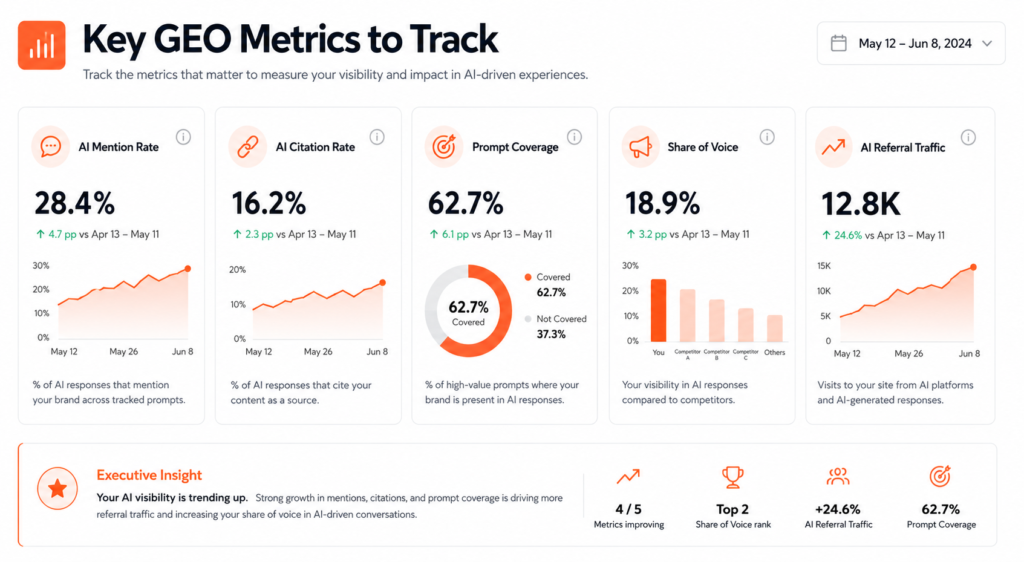
Explore GEO metrics in detail with our comprehensive guide
Create a Prompt Tracking System
One practical approach is to build a fixed prompt set based on your target buyer’s questions.
For example:
- Best B2B SEO agencies in Canada
- Top HubSpot partners for SaaS companies
- AI Search Optimization agencies
- Manufacturing SEO agencies
Run these prompts regularly across ChatGPT, Perplexity, Gemini, and AI Overviews.
Track whether your brand is:
- Cited
- Mentioned
- Recommended
- Excluded
This often provides a more accurate view of AI visibility than rankings alone.
Is GEO Replacing SEO?
No.
GEO is extending SEO, not replacing it.
Many AI systems still rely on signals traditionally associated with SEO, including:
- Crawlability
- Indexation
- Authority
- Content quality
- Backlinks
- Technical performance
Without strong SEO fundamentals, GEO efforts typically struggle to produce meaningful results.
The businesses winning in 2026 are investing in both.
The Parkyd GEO Framework
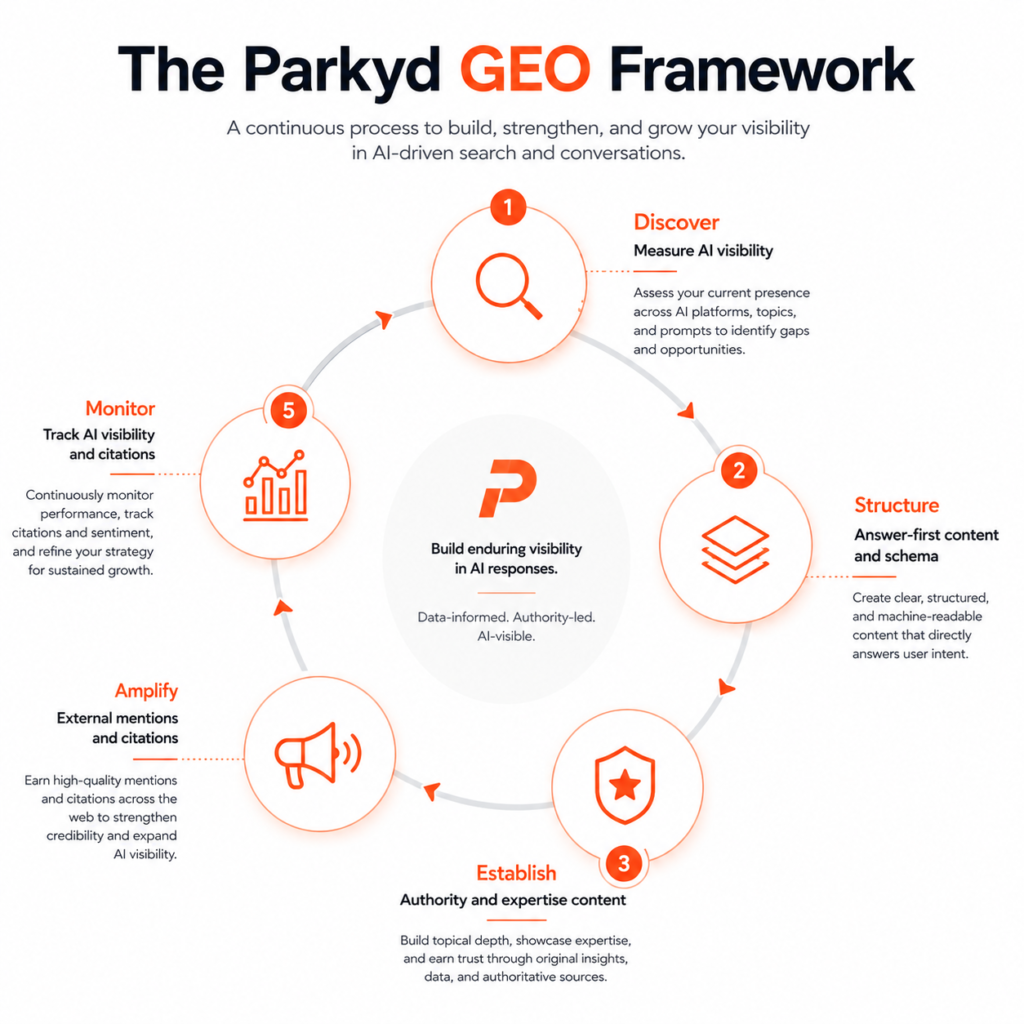
At Parkyd Digital, we view GEO as a structured process rather than a collection of tactics.
Discover
Measure current AI visibility and identify which prompts matter most to your buyers.
Structure
Build answer-first content supported by schema and strong information architecture.
Establish
Develop authority through original research, expert content, and topic clusters.
Amplify
Increase visibility through citations, mentions, comparison content, and trusted external sources.
Monitor
Track AI citations, mention rates, prompt coverage, and share of voice over time.
GEO Checklist for B2B Companies
Before investing heavily in GEO, make sure these foundations are in place:
✓ Technical SEO is healthy
✓ Brand entities are consistent
✓ Author profiles are established
✓ Structured data is implemented
✓ Key pages use answer-first formatting
✓ Comparison pages exist
✓ FAQ content is published
✓ Original research assets are available
✓ AI visibility tracking is active
✓ GEO reporting is reviewed regularly
What Should Businesses Prioritize First?
If you are just getting started, focus on these five priorities.
1. Audit Your AI Visibility
Test important buyer prompts and identify where your brand currently appears.
2. Fix Entity Signals
Standardize your company information across your website and third-party platforms.
3. Rewrite Key Pages Using Answer-First Formatting
Lead with concise answers before expanding into details and examples.
4. Implement Structured Data
Deploy Organization, Article, Author, and FAQ schema where appropriate.
5. Build Citation Assets
Invest in comparison pages, original research, expert content, and industry-specific resources that AI systems can reference.
Conclusion
GEO is about making your expertise easier to understand, easier to trust, and easier to cite.
As AI-powered discovery continues to influence how buyers research and evaluate vendors, businesses need visibility beyond traditional rankings.
The organizations that succeed will combine strong SEO fundamentals with content designed for both human readers and AI systems.
If your brand is not appearing when prospects ask ChatGPT, Perplexity, Gemini, or Google AI Overviews for recommendations, you may already be losing visibility.
Parkyd Digital helps B2B organizations build SEO and GEO strategies that improve both search rankings and AI citation visibility. Whether you are looking to measure AI citations, strengthen your authority, or create content that AI systems actually reference, our team can help.
Book a strategy session to understand where your brand stands today and what opportunities exist to improve your AI search visibility.