 5.0
5.0
 4.9
4.9
 HubSpot
 4.9
4.9

TL;DR
Manufacturing SEO works when technical searches lead to pages that answer buying questions. Map engineer and procurement queries to capability, process, material, certification, industry, product, and RFQ pages. Show specifications and proof clearly, fix crawl and duplication issues, and measure qualified RFQs—not traffic alone.
Industrial buyers rarely begin with your company name. An engineer may search for a material, tolerance, process, or certification. A procurement manager may compare suppliers by location, lead time, capacity, or quality credentials. An operations leader may search for a solution to downtime, scrap, or replacement-part availability.
That makes SEO for manufacturing companies different from publishing broad blog posts and waiting for traffic. The real opportunity is to connect technical demand with the page most capable of answering it—and to make the path from search to request for quote (RFQ) frictionless.
This guide explains how to build that system.
What is Manufacturing SEO?
Manufacturing SEO is the practice of making a manufacturer’s expertise, capabilities, products, and proof easy to find and evaluate in search. It combines keyword research, commercial page strategy, technical SEO, content, internal linking, digital authority, and conversion measurement.
A useful manufacturing SEO strategy answers three questions:
- What does the buyer need to make, source, repair, compare, or improve?
- What evidence will help that buyer decide whether your company belongs on the shortlist?
- Which page and conversion action should support that decision?
Match the page to the intent. A query such as “AS9100 5-axis CNC machining” needs a capability or industry page with verifiable specifications; a supplier-selection query may need a guide; a part-number query may need a product or replacement page.
How Industrial Buyers Search
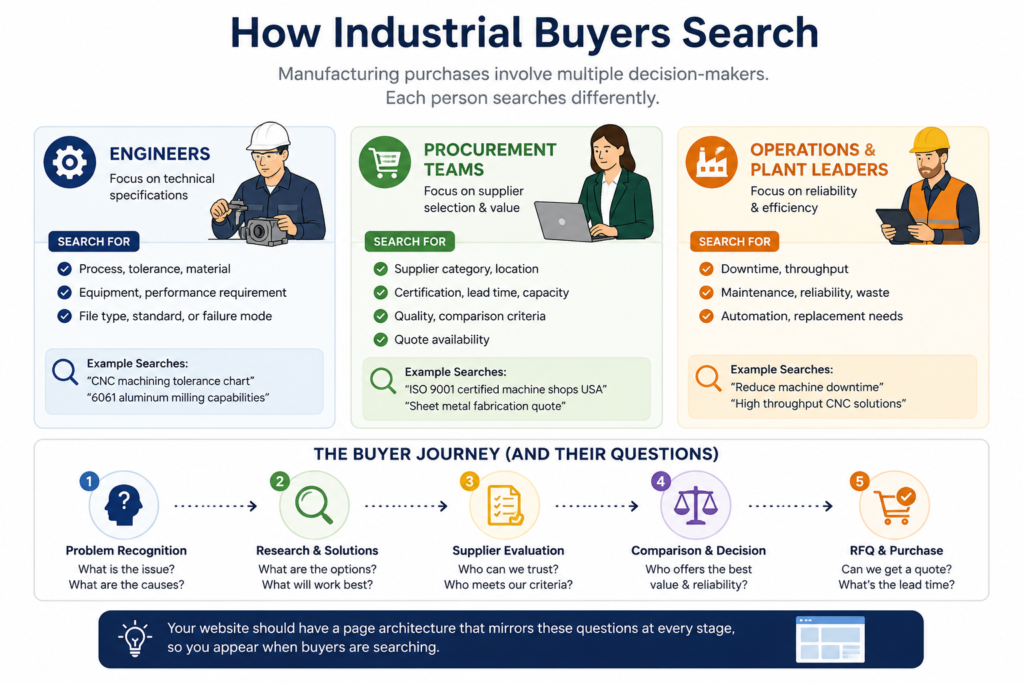
Manufacturing purchases often involve several people, and each person searches differently.
- Engineers search by process, tolerance, material, equipment, performance requirement, file type, standard, or failure mode.
- Procurement teams search by supplier category, location, certification, lead time, capacity, quality, comparison criteria, and quote availability.
- Operations and plant leaders search by downtime, throughput, maintenance, reliability, waste, automation, and replacement needs.
This is why a single “Services” page rarely captures the full opportunity. Your website needs a page architecture that mirrors the questions buyers ask as they move from problem recognition to supplier selection.
Map Buyer Intent to the Right Page
Use the following intent-to-page framework during keyword research and content planning.
Buyer intent | Typical search pattern | Best page type |
|---|---|---|
Capability | 5-axis CNC machining; metal stamping services | Capability or service page |
Specification | tight-tolerance machining; IP-rated enclosure | Specification-led capability page |
Material or process | PEEK machining; anodized aluminum parts | Material/process page |
Certification | AS9100 machine shop; ISO 13485 manufacturer | Certification plus relevant capability/industry page |
Industry or application | aerospace machining supplier; food-grade conveyor | Industry/application page |
Location | CNC machining Ontario; industrial automation Toronto | Location page only when operations and proof justify it |
Part or replacement | model number, OEM part, compatible replacement | Product, part, or support page |
Comparison | supplier comparison; process A vs. process B | Guide or comparison page |
RFQ | custom fabrication quote; machining quote | RFQ-focused landing page |
Avoid creating thin pages for every keyword variation. Combine closely related searches when the same buyer, offer, and proof satisfy them. Split pages only when the search intent or evidence genuinely changes.
A Practical Example: From Broad Traffic To Qualified RFQs
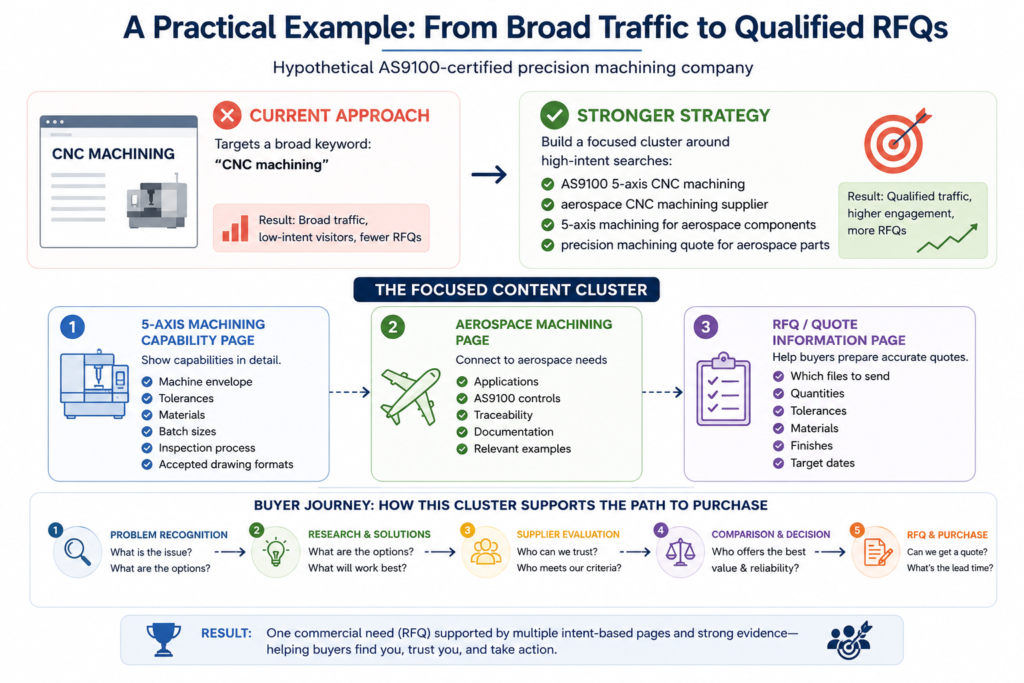
Consider a hypothetical AS9100-certified precision machining company. Its current site targets the broad phrase “CNC machining,” but the page says little about equipment, tolerances, materials, inspection, or aerospace experience.
A stronger strategy would build a focused cluster around searches such as “AS9100 5-axis CNC machining,” “aerospace CNC machining supplier,” “5-axis machining for aerospace components,” and “precision machining quote for aerospace parts.”
The cluster could include:
- A 5-axis machining capability page with machine envelope, tolerances, materials, batch sizes, inspection process, and accepted drawing formats.
- An aerospace machining page connecting applications, AS9100 controls, traceability, documentation, and relevant examples.
- An RFQ page explaining which files, quantities, tolerances, materials, finishes, and target dates help the team prepare an accurate quote.
This example is illustrative, not a Parkyd client result. Its value is the structure: one commercial need, several supporting intents, and evidence that helps the buyer advance.
Build Commercial Pages That Engineers And Procurement Teams Can Trust
Ranking a vague page does not create a strong buying experience. A high-intent manufacturing page should make qualification easier.
Include the proof relevant to the offer:
- Processes, equipment, capacity, service range, and production volumes.
- Materials, tolerances, dimensions, finishes, and applicable standards.
- Certifications, quality systems, inspection methods, traceability, and documentation.
- Industries and applications served, with real constraints and use cases.
- A clear RFQ checklist and a simple route to upload drawings or contact sales.
Do not publish confidential dimensions, customer information, controlled data, or claims the company cannot substantiate. Specificity builds trust only when it is accurate.
Fix Technical SEO Problems Common To Manufacturing Websites
Manufacturing sites often contain large catalogs, faceted filters, distributor pages, PDFs, legacy product URLs, and regional variants. These can create duplicate or thin pages and make important commercial content harder to crawl.
Prioritize the following:
- Crawlability and indexation: confirm important pages are accessible, indexable, included in clean sitemaps, and not blocked unintentionally.
- Canonicalization: consolidate duplicate or near-duplicate URLs created by parameters, filters, pagination, print views, and catalog systems.
- Catalog quality: avoid indexing every combination when a page offers no unique demand, content, or buyer value.
- PDF strategy: keep useful CAD files, certificates, and datasheets, but pair important documents with an HTML page that summarizes the facts and links to the file.
- Mobile performance: make specifications, navigation, forms, and drawing-upload steps usable on a phone, even when many buyers complete the RFQ later on desktop.
- Internal linking: connect guides to the relevant capability, certification, industry, product, and RFQ pages.
Create Content That Can Support Search And AI Recommendations
AI-search visibility is not a separate shortcut. Google says its standard SEO fundamentals also apply to AI features: publish helpful, reliable, indexable content and make important information available in text.
To make manufacturing content easier for people and systems to understand:
- Answer one clear question in each section and use descriptive headings.
- Put important specifications and qualifications in visible page text, not only in images or PDFs.
- Support claims with first-party proof and authoritative sources.
FAQs can improve the reader experience, but do not promise an FAQ rich result. Google generally restricts FAQ rich results to authoritative government and health sites.
Measure What Matters: Qualified Pipeline, Not Traffic Alone
Organic sessions are useful diagnostic data, but they are not the business outcome. Manufacturing SEO should be evaluated against the actions that signal a credible buying process.
Track:
- Qualified RFQ and quote-request submissions.
- Sales-qualified leads, opportunities, pipeline, and revenue when CRM attribution is reliable.
Connect Search Console, analytics, form tracking, and the CRM. Review lead quality with sales so content priorities reflect revenue potential rather than raw traffic.
A 90-Day Manufacturing SEO Action Plan
- Days 1–30: Audit indexation, duplicate URLs, speed, analytics, conversion paths, rankings, authority, and priority pages.
- Days 31–60: Group keywords by buyer intent, map them to pages, prioritize commercial value, and prepare the first capability and industry assets.
- Days 61–90: Publish priority pages and the guide, improve internal links and RFQ tracking, then review early query and lead-quality signals.
SEO compounds over time, but the operating discipline starts immediately: answer a real buyer question, show the evidence, make the next step clear, and learn from the quality of the response.
Manufacturing SEO Checklist
- Buyer roles and high-intent search patterns are documented.
- Every target keyword has one primary page and purpose.
- Capability pages contain specifications and qualification proof.
- Certification and industry claims are current and verifiable.
- Catalog, filter, PDF, and regional duplication are controlled.
- Guides link naturally to commercial pages and the RFQ path.
- Forms request enough information to qualify without creating unnecessary friction.
- Search Console, analytics, and CRM tracking connect content to lead quality.
Request a manufacturing SEO opportunity assessment to identify the highest-value search, content, and conversion opportunities for your website.
FAQ’s
How long does manufacturing SEO take?
Timelines vary by site condition, competition, authority, and publishing capacity. Technical and conversion improvements can help sooner; durable organic growth usually requires sustained work.
Should manufacturers create a page for every keyword?
No. Create a separate page when the buyer’s intent, offer, or proof changes. Closely related keyword variations should usually be handled by one complete page to avoid thin content and cannibalization.
Do manufacturers need special optimization for AI search?
No special markup guarantees inclusion in AI answers. Use sound SEO, clear and accurate content, visible evidence, consistent entities, accessible pages, and structured data that matches the page.
Turn search demand into qualified manufacturing opportunities?
If your website attracts traffic but not the right RFQs, the gap may be intent mapping, commercial-page depth, technical SEO, or conversion design. Parkyd Digital can identify the highest-value opportunities and the obstacles preventing qualified buyers from taking the next step.
