 5.0
5.0
 4.9
4.9
 HubSpot
 4.9
4.9

TL;DR
- Prioritize queries connected to customer problems, product use cases, demos, trials, and revenue, not traffic alone.
- High-intent keywords often include “software,” “pricing,” “alternatives,” “vs,” “integration,” or a specific industry or use case.
- Start with sales, CRM, support, paid-search, and Search Console data, not just SEO tools.
- Match every keyword cluster to the page type that best satisfies its intent, then measure qualified conversions and pipeline.
Many SaaS companies grow organic traffic without seeing a comparable increase in demos, trials, or sales opportunities. The problem is often a disconnect between what the company ranks for and what buyers search when solving a problem or evaluating software.
Effective SaaS keyword research closes that gap. It connects buyer language and product value with search demand, then turns those insights into pages designed to help—and convert—the right audience.
What Is SaaS Keyword Research?
SaaS keyword research is the process of finding, evaluating, and prioritizing search queries that align with a software product, its ideal customers, and the buying journey.
Unlike a traffic-first approach, it asks:
- Does this query describe a problem our product solves?
- Which page would best help them take the next step?
- Could traffic from this query reasonably lead to a trial, demo, or qualified conversation?
Search volume and ranking difficulty still matter, but they are supporting metrics. A low-volume query closely tied to a valuable use case can be more commercially useful than a broad term that attracts thousands of visitors with little reason to buy.
What Makes a SaaS Keyword High Intent?
Search intent is the outcome a person wants from a search. For SaaS marketers, it helps to view intent in four practical stages:
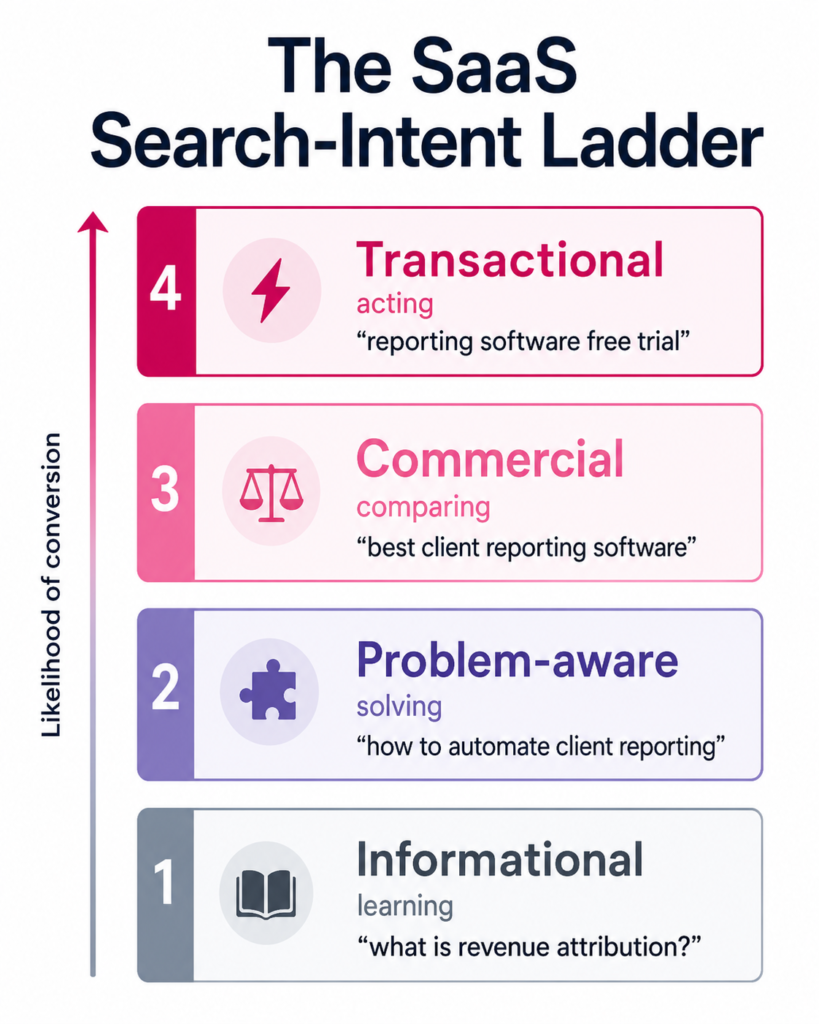
Intent | What the searcher is doing | Example |
Informational | Learning about a concept | “What is revenue attribution?” |
Problem-aware | Trying to solve a specific issue | “How to automate client reporting” |
Commercial | Comparing possible solutions | “Best client reporting software for agencies” |
Transactional | Preparing to act | “AgencyAnalytics pricing” or “reporting software free trial” |
Commercial and transactional searches sit closest to purchase, but a specific problem-aware query can also be valuable when it maps directly to the product.
Common high-intent SaaS keyword patterns include:
- [category] software or [category] platform
- best [category] software for [industry or use case]
- [competitor] alternatives
- [product] vs [competitor]
- [product or category] pricing
- [software] integration with [platform]
- [solution] for [role, industry, or company type]
- how to solve [urgent, product-relevant problem]
Modifiers are clues, not proof. Inspect the results. If product, comparison, review, or integration pages dominate, your content type should reflect that commercial intent.
How to Find High-Intent SaaS Keywords
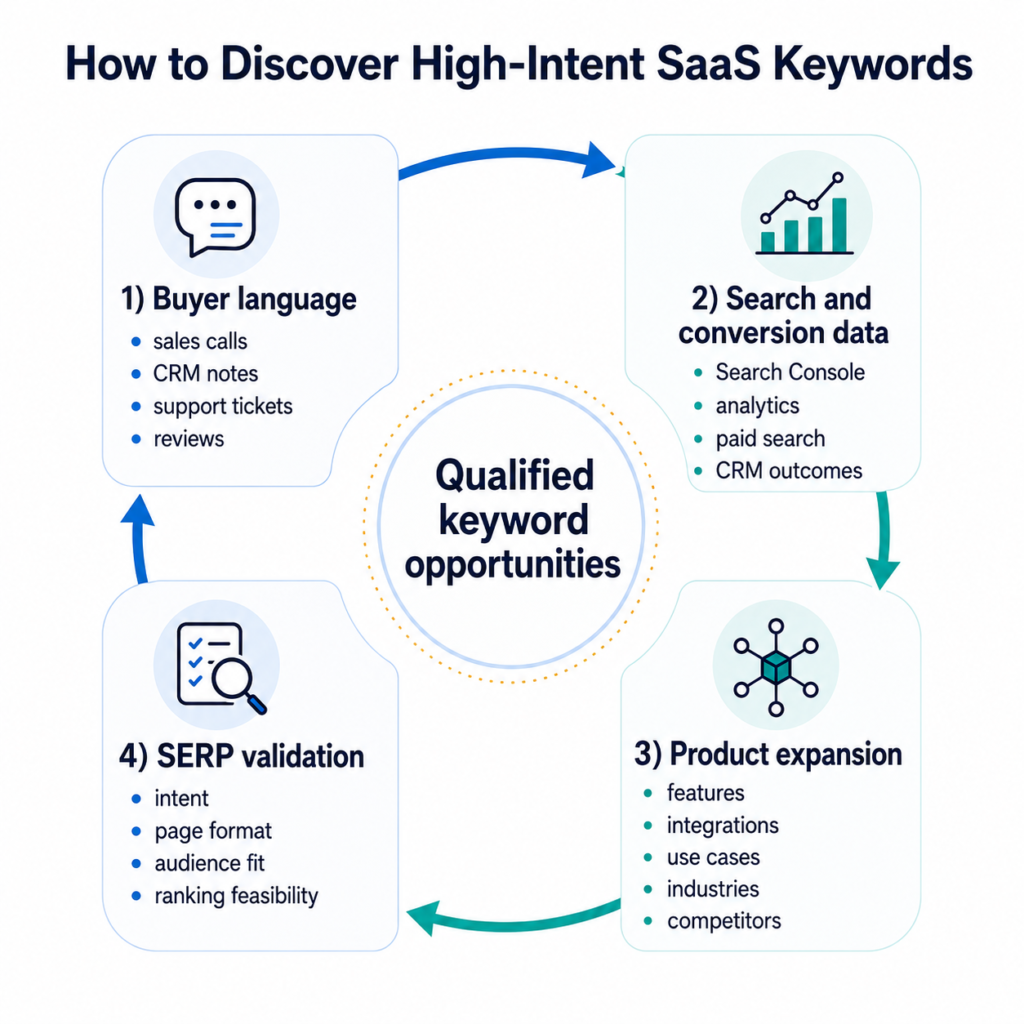
The strongest research process combines first-party customer evidence with search data.
1. Start with buyer language
Review sales calls, CRM records, lost-deal reasons, support tickets, interviews, and product reviews. Capture how customers describe:
- purchase triggers and problems;
- required features and integrations;
- alternatives and objections;
- desired outcomes.
Turn recurring phrases into seed topics. “We cannot reconcile MRR across Stripe and QuickBooks” may lead to searches around SaaS revenue reconciliation, accounting integrations, or MRR reporting software.
2. Use your existing search and conversion data
The Google Search Console Performance report shows queries receiving impressions and clicks. Look for product-relevant searches outside the top results, intent mismatches, and clusters already generating qualified visits.
Keywords producing meaningful paid conversions deserve organic consideration, although paid performance does not guarantee organic success. Connect analytics with your CRM to distinguish form fills from qualified opportunities.
3. Expand around the product
Build seed lists from your category, features, integrations, use cases, industries, roles, and competitors. Combine them with modifiers such as “software,” “best,” “versus,” “alternative,” “pricing,” and “integration.”
Expand the list with keyword tools, autocomplete, related searches, communities, and competitor sites. Treat third-party volume estimates as directional, not a complete record of niche demand.
4. Validate the search results
Review the current results and ask:
Check which page formats rank: guides, product pages, lists, comparisons, or tools.
- Do they serve your audience and use case?
- Can you create a genuinely better resource in the expected format?
If Google consistently ranks product pages, publishing another educational article is unlikely to satisfy the query as well as a strong commercial landing page.
Prioritize Keywords with a Buyer-Intent Score
To move beyond volume and difficulty, score each keyword from 1 to 5 across six factors:
- Business relevance: How closely does it align with your market and ideal customer?
- Buyer intent: Does the query suggest active problem-solving, evaluation, or action?
- Product fit: Can your product credibly deliver the desired outcome?
- Conversion potential: Do comparable pages or campaigns generate qualified conversions?
- Ranking feasibility: Can your site realistically compete with the current results?
- Sales value: What is the likely value of opportunities associated with this need?
Add the ratings for a maximum of 30. This is a prioritization aid, not a scientific standard. Explain each score and favor opportunities supported by first-party customer or conversion evidence.
Match Each Keyword to the Right Page
Not every keyword should become a blog post. Use the dominant intent to select the page:
- Product and feature pages: category, capability, and feature-led searches
- Use-case pages: problems tied to a specific role, workflow, or industry
- Integration pages: searches connecting your product with another platform
- Comparison and alternative pages: “vs,” “alternatives,” and evaluation searches
- Pricing pages: branded pricing and packaging questions
- Guides: complex problems that require education before solution evaluation
Assign one primary page to each intent cluster to reduce overlap and give every page a clear role.
Optimize for Google Search and AI Experiences
Google says the same SEO foundations apply to AI Overviews and AI Mode; there are no special requirements or guaranteed methods for inclusion. A page must be indexable and eligible to appear with a snippet.
For readers and answer systems, make the guide easy to understand and verify:
- answer the main question early;
- use descriptive headings and self-contained explanations;
- add original examples, frameworks, or first-party observations;
- cite reliable sources for factual claims;
- show a knowledgeable author and transparent company information;
- support the article with useful, relevant visuals;
- use accurate Article and Breadcrumb structured data.
Google’s people-first guidance emphasizes original value and a satisfying experience—not pages made mainly to capture traffic.
Measure Pipeline, Not Just Rankings
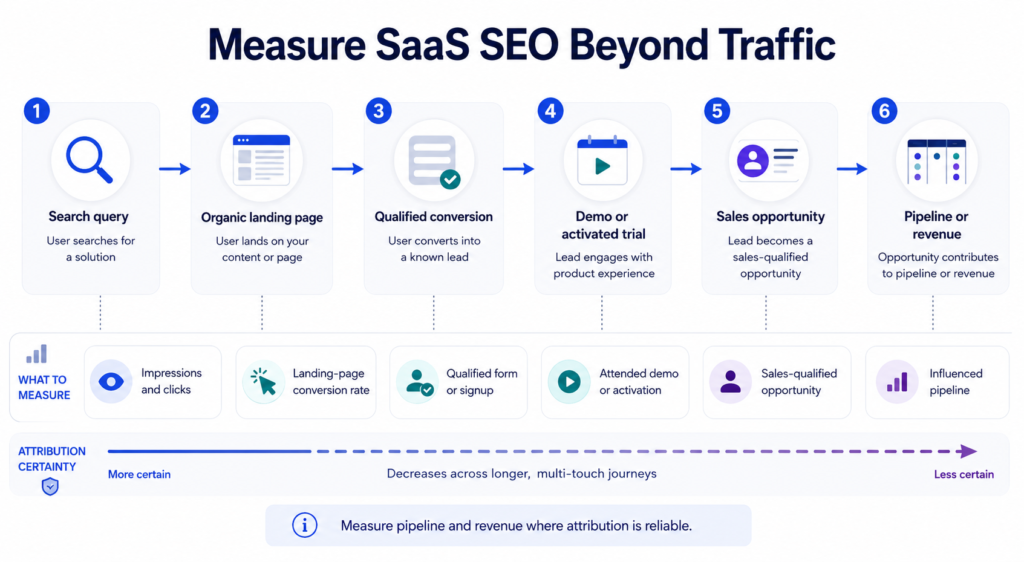
Connect rankings, impressions, clicks, and click-through rate to:
- qualified organic form submissions;
- sign-ups, activated trials, and attended demos;
- sales-qualified leads and opportunities;
- conversion rate by landing page and intent cluster;
- pipeline and revenue where attribution is reliable.
If a ranking page attracts unqualified visitors, reassess its intent and offer. If a low-volume page produces valuable opportunities, strengthen its supporting cluster and internal links.
A Quick SaaS Keyword Research Checklist
- Do priority keywords connect to product value and buyer problems?
- Have sales, CRM, customer, support, and paid-search insights informed the list?
- Has the current search results page been reviewed for intent and format?
- Does each keyword cluster have one appropriate destination page?
- Are low-volume, high-fit opportunities included?
- Can conversions be traced from landing pages into the CRM?
- Is performance reviewed using a qualified pipeline rather than traffic alone?
Turn SaaS Search Demand into Qualified Pipeline
SaaS keyword research connects buyer language with the pages, offers, and product evidence needed to make a decision. It requires collaboration across SEO, content, product, sales, and revenue operations.
If your current strategy generates traffic but not enough qualified opportunities, Parkyd Digital can help you identify high-intent gaps, map them to the right pages, and build an SEO program measured against demos, trials, and pipeline.
Book a free SEO consultation to discuss your SaaS keyword opportunities.
FAQs
How can you tell whether a SaaS keyword has high buyer intent?
Look for a specific problem, category, use case, comparison, integration, pricing question, or action. Inspect the results to confirm commercial or product-focused intent.
Should SaaS companies target zero-volume keywords?
Sometimes. Test low-volume terms when they closely match the product and ideal customer, then validate them with Search Console, paid data, and conversions.
How often should a SaaS keyword strategy be reviewed?
Review performance quarterly and whenever the product, positioning, target market, or competitive landscape changes.