 5.0
5.0
 4.9
4.9
 HubSpot
 4.9
4.9

TL;DR
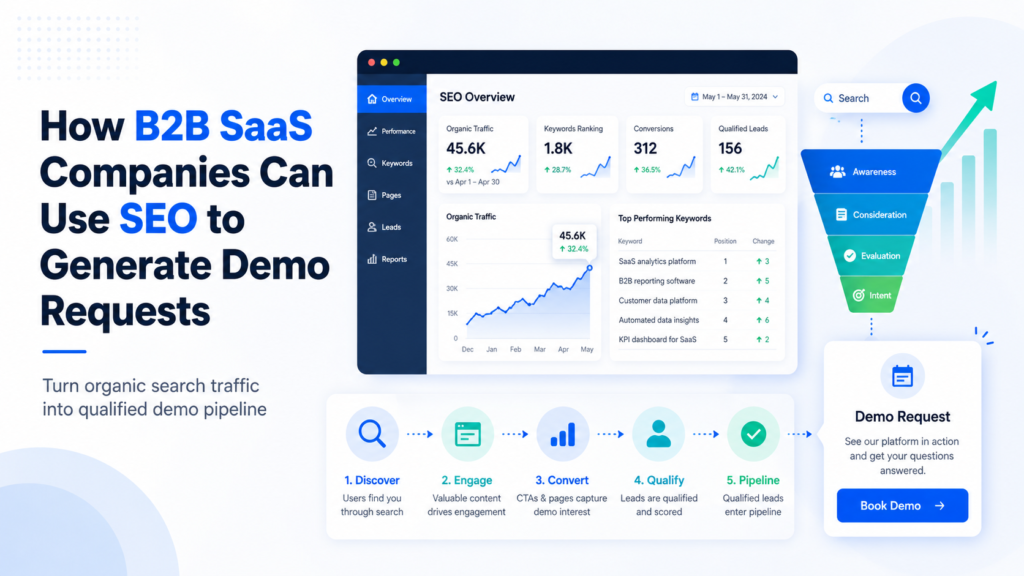
- B2B SaaS SEO should not be measured only by traffic, rankings, or impressions. It should be measured by qualified demo requests, SQLs, assisted pipeline, and revenue influence.
- Most SaaS websites do not need more blog traffic first. They need high-intent pages that match how buyers compare software before booking a demo.
- The strongest demo-generating SEO pages include use-case pages, industry pages, competitor comparison pages, alternative pages, integration pages, pricing pages, and case studies.
- To optimize a SaaS website for demos, you need clear messaging, strong CTAs, short forms, trust signals, fast pages, and simple conversion paths.
- AI search now affects how buyers discover and compare SaaS vendors, so content should include clear definitions, comparison tables, FAQs, source-backed claims, and structured answers.
- HubSpot or CRM attribution should connect organic search to form submissions, lifecycle stages, SQLs, deals, and revenue.
- Parkyd Digital helps B2B SaaS companies build SEO systems that connect organic visibility, AI search, website conversion, HubSpot attribution, and pipeline growth.
Your SaaS Website Might Not Have a Traffic Problem
Your SaaS website might not have a traffic problem.
It might have a demo conversion problem.
Many B2B SaaS companies invest in SEO, publish blogs, and grow organic traffic. But when the sales team checks the calendar, there are still not enough qualified demos.
That happens because traditional SEO often focuses on clicks. B2B SaaS SEO has to focus on buying intent.
A SaaS buyer does not usually book a demo after reading one generic blog. They research the problem, compare software, check integrations, ask about pricing, review alternatives, look for proof, and then decide whether the product is worth a sales conversation.
That means your SEO strategy needs to support the full path from search to demo request.
What Is B2B SaaS SEO?
B2B SaaS SEO is an organic growth strategy for software companies that sell to businesses. Its goal is to help the right buyers discover, evaluate, trust, and choose your software through search.
It includes:
- Technical SEO
- Product and landing page optimization
- High-intent keyword targeting
- Use-case and industry content
- Comparison and alternative pages
- AI SEO and answer engine optimization
- Internal linking
- Conversion rate optimization
- HubSpot or CRM attribution
Google’s SEO Starter Guide explains that search-friendly content should be helpful, reliable, and easy for search engines to crawl and understand. For SaaS companies, that means content should answer real buyer questions and lead users toward meaningful next steps.
The next step for a sales-led SaaS company is usually a demo request.
Why Demo Requests Are the Right SEO Goal for Sales-Led SaaS
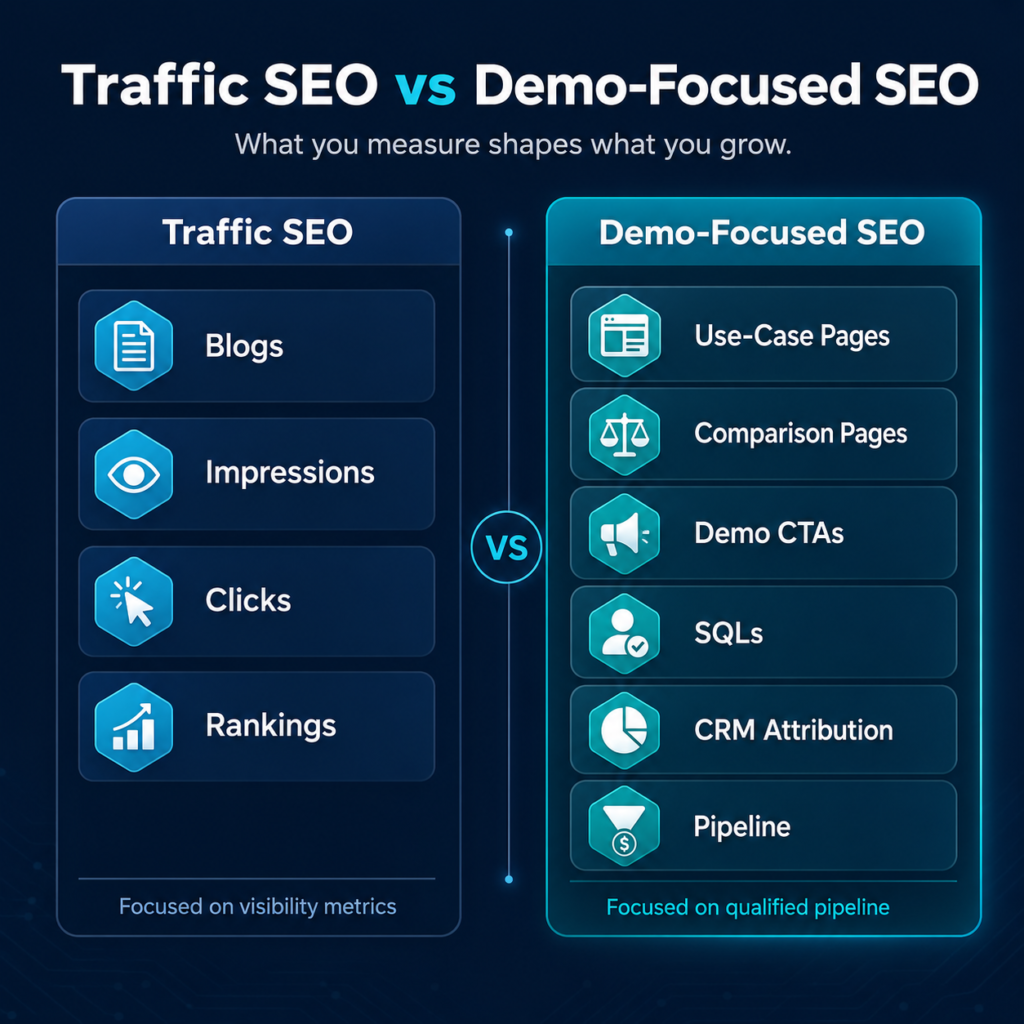
Traffic is useful, but traffic alone is not a pipeline.
A blog post ranking for “what is CRM” may bring thousands of visitors. But many of those visitors may be students, junior employees, or early researchers with no purchase timeline.
A page ranking for “best CRM for B2B agencies” may bring fewer visitors, but those visitors are much closer to evaluating software.
That is the difference between traffic SEO and demo-focused SEO.
For sales-led SaaS companies, SEO should help generate:
- Demo requests
- Free trial signups
- Sales-qualified leads
- Pricing page visits
- Contact form submissions
- Assisted pipeline
- Content-influenced revenue
- Lower dependency on paid acquisition
HubSpot’s attribution reporting helps teams assign credit to marketing interactions that create contacts, deals, and revenue. That is why SaaS teams should connect organic search performance to CRM outcomes, not just GA4 traffic reports.
Why Most SaaS SEO Does Not Generate Demos
Many SaaS SEO programs fail because they are built like publishing calendars, not revenue systems.
Common problems include:
- Too much top-of-funnel content
- No comparison pages
- No alternative pages
- Weak product pages
- No use-case or industry pages
- Poor internal linking to demo pages
- Generic CTAs like “Learn More”
- Long demo forms with too much friction
- Weak trust signals near conversion points
- No HubSpot or CRM attribution
- No clear strategy for AI search visibility
For example, a cybersecurity SaaS company may publish 100 blogs about security awareness but still miss keywords like “best endpoint protection for SMB,” “EDR vs XDR,” or “CrowdStrike alternative.”
Those are the searches that signal evaluation.
If your SEO only educates buyers but does not help them compare, validate, and act, it will struggle to generate demos.
B2B SaaS SEO Framework for Demo Requests
1. Define the ICP and Buying Committee
Before keyword research, define who the content is for.
A B2B SaaS purchase may involve:
- Founder or CEO
- CMO or Head of Growth
- VP Sales
- RevOps leader
- Finance team
- IT or security team
- Daily end users
Each person searches differently.
A founder may search for ROI. A RevOps leader may search for integrations. An IT leader may search for security. A user may search for workflows and ease of use.
Your SEO strategy should answer all of these questions.
2. Map Demo-Intent Keywords
Demo-intent keywords are searches that suggest the buyer is comparing options, checking fit, or preparing to speak with sales.
Examples:
- “CRM for agencies”
- “HubSpot alternatives”
- “Salesloft vs Outreach”
- “HR software for healthcare”
- “project management software pricing”
- “Salesforce Slack integration”
These keywords usually have lower search volume than broad educational terms, but they have higher commercial value.
3. Build the Right Landing Pages
If the keyword has buying intent, do not send users to a generic blog.
Send them to a focused page.
Examples:
- Use-case keyword = use-case page
- Industry keyword = industry page
- Alternative keyword = alternative page
- Comparison keyword = comparison page
- Pricing keyword = pricing page
- Integration keyword = integration page
The page should answer the search intent and make the next step obvious.
4. Link Blogs to Demo-Focused Pages
Blogs can support demo generation, but only when they guide readers toward commercial pages.
For example:
A blog on “how to improve sales forecasting accuracy” should internally link to:
- CRM for sales forecasting page
- Sales analytics software page
- Case study
- Demo page
Without internal links, the blog becomes a dead end.
5. Improve CTA Placement
Your demo CTA should appear:
- Above the fold
- In the sticky header
- After important proof sections
- Near comparison tables
- After FAQs
- At the end of the page
Do not rely on one CTA at the bottom of the page.
6. Add Proof Before the Form
Buyers need confidence before booking a demo.
Add trust signals like:
- Customer logos
- Short testimonials
- G2 or review badges
- Case studies
- Security badges
- Integration proof
- Implementation timelines
- Results or benchmarks
The goal is to reduce doubt before the form.
7. Shorten the Demo Form
Long forms can create friction. CXL’s research and form guidance notes that fewer fields often improve conversion, although every form should be tested because context matters.
For most SaaS demo forms, start with:
- Name
- Work email
- Company name
- Role or company size
You can collect more details later through enrichment, qualification, or the sales call.
8. Track Everything in HubSpot or Your CRM
If a buyer reads a blog, visits a comparison page, returns later, and books a demo, your CRM should capture that journey.
Track:
- Original source
- Referring page
- Landing page
- Demo form submission
- Lifecycle stage
- SQL status
- Deal creation
- Revenue influence
Without attribution, SEO will always look weaker than it actually is.
Demo-Intent Keywords for B2B SaaS SEO
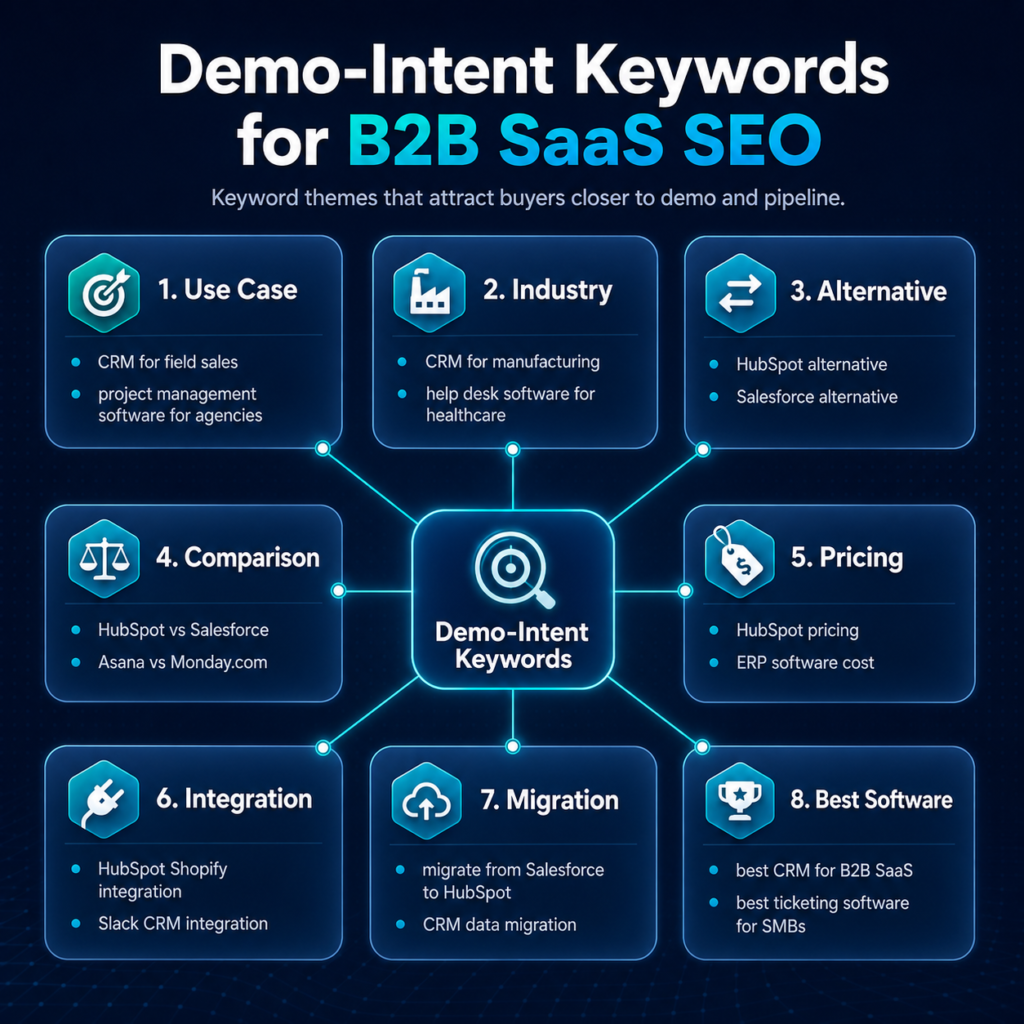
Keyword Type | Example Search | Buyer Intent | Recommended Page | Demo Value |
Use-case | CRM for sales forecasting | Checking workflow fit | Use-case page | High |
Industry | HR software for healthcare | Checking vertical fit | Industry page | High |
Alternative | HubSpot alternatives | Considering a switch | Alternative page | Very high |
Comparison | Salesloft vs Outreach | Final vendor evaluation | Comparison page | Very high |
Pricing | Zendesk pricing per seat | Budget validation | Pricing page | Very high |
Integration | Salesforce Slack integration | Checking tech-stack fit | Integration page | High |
Migration | Migrate from Salesforce to HubSpot | Evaluating switching effort | Migration page | High |
Best software | Best CRM for agencies | Building a shortlist | Listicle or category page | High |
Problem-to-solution | Automate lead assignment | Looking for a solution | Product-led guide | Medium to high |
SaaS Pages That Should Generate Demo Requests
Homepage
Your homepage should clearly explain:
- What your product does
- Who it is for
- What problem it solves
- Why buyers should trust you
- What action they should take next
CTA recommendation:
Use a clear CTA like “Book a Demo” or “See the Platform in Action.”
Product or Category Pages
These pages target your main software category.
Examples:
- Inventory management software
- Sales engagement software
- HR onboarding software
- Customer support platform
CTA recommendation: Place a demo CTA above the fold and repeat it after feature, proof, and FAQ sections.
Use-Case Pages
Use-case pages show how your product solves a specific workflow problem.
Examples:
- CRM for sales forecasting
- Project management software for client work
- Analytics software for revenue teams
CTA recommendation: Make the CTA specific to the use case, such as “See how sales teams forecast pipeline.”
Industry Pages
Industry pages help buyers feel that your product fits their market.
Examples:
- HR software for healthcare
- CRM for manufacturing
- Compliance software for financial services
CTA recommendation: Use industry-specific language like “Book a healthcare workflow demo.”
Alternative Pages
Alternative pages target buyers who are unhappy with a current tool or comparing market options.
Examples:
- HubSpot alternative
- Asana alternative
- Zendesk alternative
CTA recommendation: Offer a comparison-led CTA like “Compare your options with us.”
Competitor Comparison Pages
Comparison pages help buyers decide between two or more vendors.
Examples:
- HubSpot vs Salesforce
- Monday vs ClickUp
- Salesloft vs Outreach
CTA recommendation: Place the CTA after the comparison table and after the “best for” section.
Integration Pages
Integration pages reduce technical uncertainty.
Examples:
- Salesforce Slack integration
- HubSpot Shopify integration
- QuickBooks CRM integration
CTA recommendation: Use a CTA like “See how the integration works.”
Pricing Pages
Pricing pages help buyers validate budget before speaking to sales.
If you cannot show exact pricing, explain pricing factors.
CTA recommendation:
Use “Request pricing” or “Book a pricing walkthrough.”
Case Studies
Case studies provide proof that your software works.
A strong SaaS case study should include:
- Customer problem
- Why they chose your product
- Implementation process
- Results
- Quote or testimonial
- CTA to book a similar walkthrough
CTA recommendation: Use “See how this could work for your team.”
Demo Landing Page
Your demo page should be simple and conversion-focused.
It should include:
- Clear headline
- Short explanation of what happens in the demo
- Short form
- Calendar option if possible
- Customer logos
- Testimonials
- Security or trust proof
- FAQ section
CTA recommendation: Use direct language like “Book a 20-minute demo.”
How to Optimize a SaaS Website for Demo Requests
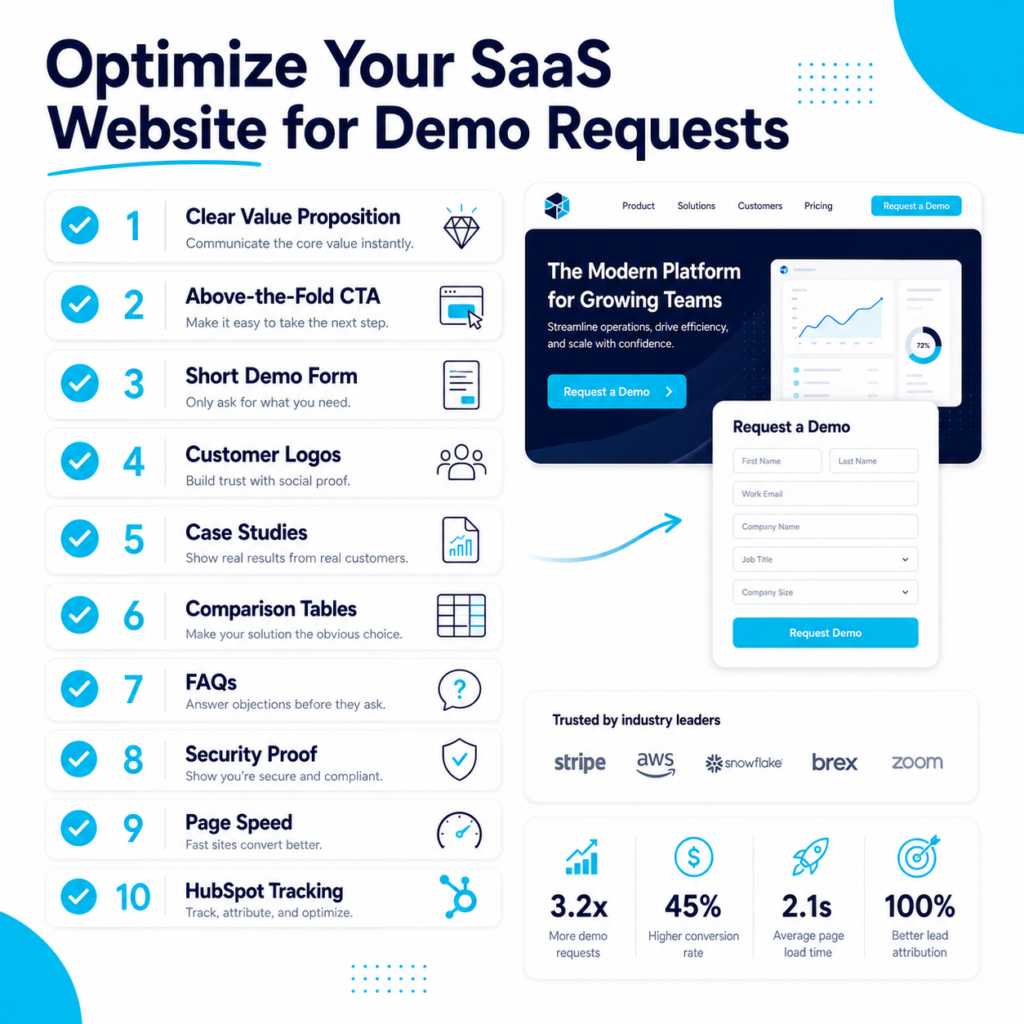
Ranking on page one is only half the work. The page still needs to be converted.
1. Make the Value Proposition Clear
Your hero section should answer three questions quickly:
- What does the product do?
- Who is it for?
- What result does it help create?
Avoid vague headlines like “Scale faster with AI.”
Use clearer positioning like:
“AI-powered revenue forecasting software for B2B SaaS sales teams.”
2. Use Demo CTA Language That Sets Expectations
Instead of:
“Submit”
Use:
- Book a demo
- See it in action
- Get a 20-minute walkthrough
- Talk to a product expert
- Request a pricing walkthrough
Specific CTA copy reduces uncertainty.
3. Place CTAs Where Buyers Need Them
Place demo CTAs:
- In the hero section
- In the sticky navigation
- After feature sections
- Beside proof points
- After comparison tables
- Near pricing explanations
- After FAQs
4. Reduce Form Friction
Ask only for what sales truly needs at the first step.
For enterprise SaaS, some qualification fields may be necessary, but avoid asking for too much too soon.
5. Add Trust Signals Near CTAs
Trust signals work best when they appear near decision points.
Examples:
- “Trusted by 120+ B2B SaaS teams”
- Customer logos
- G2 rating
- Security compliance badges
- Case study link
- Short testimonial
6. Use Comparison Tables
Comparison tables help buyers scan faster.
They are useful for:
- Competitor pages
- Alternative pages
- Pricing pages
- Feature pages
- Best software pages
They also make content easier for AI systems to summarize.
7. Improve Page Speed and Mobile UX
Slow pages create friction. Google’s SEO guidance emphasizes building pages that users can access and search engines can crawl effectively.
For SaaS websites, mobile matters because decision-makers may research on mobile even if they convert later on desktop.
8. Track Thank-You Pages and Form Events
Every demo form should trigger proper tracking.
Track:
- Form submit event
- Thank-you page visit
- Calendar booking
- CRM contact creation
- Lifecycle stage
- Sales handoff
- Deal creation
This makes SEO accountable to the pipeline.
Content Strategy That Turns SEO Traffic Into Demos
A demo-focused SaaS content strategy should not be a random blog calendar.
It should be built around buyer intent.
Priority 1: Build Commercial Pages First
Start with pages that have the strongest connection to demos:
- Product pages
- Use-case pages
- Industry pages
- Alternative pages
- Comparison pages
- Pricing pages
- Integration pages
Priority 2: Support Them With MOFU Content
Then create content that helps buyers evaluate:
- Buying guides
- Implementation guides
- Migration checklists
- ROI explainers
- Feature comparisons
- Security explainers
- Product-led use cases
Priority 3: Use TOFU Content for Authority
Top-of-funnel content can still help, but it should connect to product demand.
For example:
Weak topic:
“What is productivity?”
Better topic:
“How RevOps teams can reduce lead response time with automated lead routing”
The second topic is still educational, but it is closer to a product problem.
Technical SEO for SaaS Demo Generation
Technical SEO affects both visibility and conversion.
Key areas include:
- Crawlability
- Indexability
- JavaScript rendering
- Page speed
- Core Web Vitals
- Internal linking
- Schema markup
- Duplicate content
- Canonicals
- Broken links
- Product documentation
- Help center SEO
- Landing page performance
Many SaaS websites are built on React, Next.js, Webflow, HubSpot CMS, or other modern frameworks. That is fine, but important content must still be crawlable and indexable.
If Google cannot access the content, buyers will not find the page.
If users find the page but it loads slowly or has a confusing CTA, they may not book a demo.
AI Search and Answer Engine Optimization for SaaS
AI search is changing how SaaS buyers build vendor shortlists.
A buyer may ask:
- What is the best CRM for small B2B SaaS teams?
- Which project management software is best for agencies?
- What are the top HubSpot alternatives?
- Which tools integrate with Salesforce and Slack?
- What should I compare before buying HR software?
Google’s AI guidance says optimization for generative AI search is still SEO from Google’s perspective, and website owners should continue applying foundational SEO best practices for AI features like AI Overviews and AI Mode.
To improve AI visibility, SaaS content should include:
- Clear definitions
- Direct answers
- Comparison tables
- FAQs
- Source-backed claims
- Case studies
- Consistent product positioning
- Author expertise
- Schema markup
- Strong internal links
- External brand mentions
The goal is not to trick AI tools. The goal is to make your brand easier to understand, trust, and recommend.
Tracking SEO to SQLs in HubSpot
You cannot improve what you cannot measure.
If a buyer finds you through Google, reads a blog, visits a comparison page, returns later, and books a demo, your reporting should capture that path.
In HubSpot, track:
- Original source
- Latest source
- Landing page
- First conversion
- Demo form submission
- Lifecycle stage
- SQL status
- Deal creation
- Revenue
HubSpot attribution reports can use contact, deal, or revenue data sources to understand how marketing interactions contribute to business outcomes. This is what turns SEO from a traffic channel into a revenue channel.
Core B2B SaaS SEO Lead Generation Metrics
Metric | Why It Matters | How to Track | What Good Looks Like |
Organic demo requests | Shows direct demand from SEO | HubSpot forms and CRM source | More qualified demos from organic |
Form conversion rate | Shows page efficiency | Page sessions vs form submissions | Higher conversion without lower lead quality |
SQLs from organic | Measures lead quality | Lifecycle stage reporting | More organic leads accepted by sales |
Assisted pipeline | Shows SEO influence | Multi-touch attribution | Organic helps create or influence deals |
Demo page conversion rate | Measures demo page strength | Demo page analytics | More visitors become booked calls |
BOFU keyword rankings | Shows commercial visibility | Rank tracking | Rankings for comparison, pricing, and use-case terms |
Organic traffic to money pages | Shows demand capture | GA4 and Search Console | More traffic to product and demo-focused pages |
Trial signups | Shows product interest | Product analytics and CRM | More trials from high-intent pages |
Organic lead quality | Shows fit | Sales feedback and CRM data | Higher ICP match and better close potential |
Content-assisted revenue | Connects content to deals | CRM attribution | Content influences closed-won opportunities |
AI mention rate | Shows AI visibility | Manual AI prompt tracking | More mentions for relevant vendor queries |
AI citation rate | Shows source authority | AI visibility monitoring | More citations from relevant answer engines |
90-Day Plan to Generate More Demo Requests From SEO
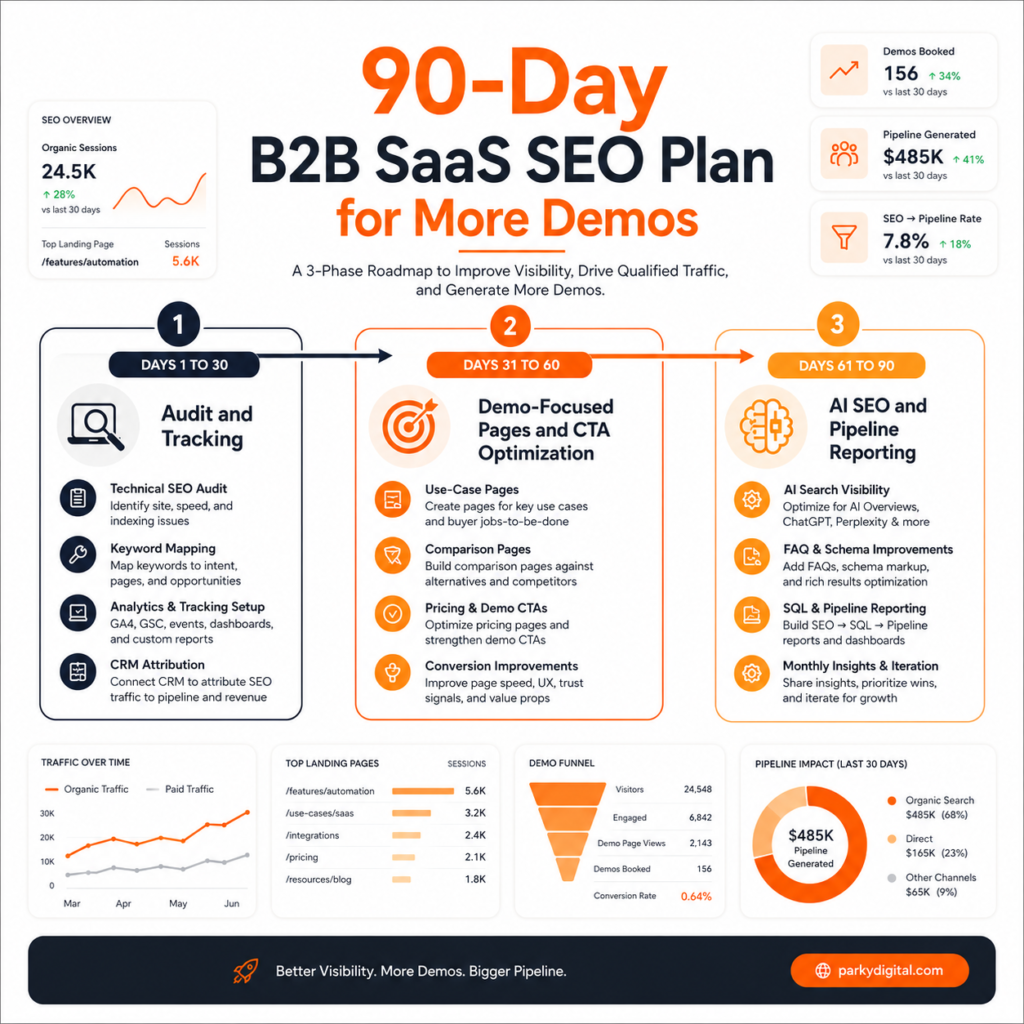
Days 1 to 30: Audit and Tracking
Focus on finding gaps.
Actions:
- Audit technical SEO
- Review current demo conversion paths
- Check organic traffic to product pages
- Identify missing high-intent pages
- Review demo form friction
- Set up HubSpot attribution
- Map keywords by buyer intent
- Review internal links to demo pages
Outcome:
You know which pages, keywords, and conversion paths are stopping SEO from producing demos.
Days 31 to 60: Build and Optimize Demo-Focused Pages
Focus on action.
Actions:
- Build use-case pages
- Build comparison or alternative pages
- Improve pricing or cost content
- Add trust signals near CTAs
- Shorten demo forms
- Add sticky demo CTAs
- Improve internal links from blogs
- Add FAQs and schema
Outcome:
Your website starts turning high-intent traffic into more qualified sales conversations.
Days 61 to 90: Expand Content and AI Visibility
Focus on scaling.
Actions:
- Publish MOFU buying guides
- Add product-led examples
- Add comparison tables
- Improve AI-friendly answer sections
- Add case studies
- Review organic demo and SQL data
- Refresh pages based on conversion performance
- Build a pipeline-focused SEO dashboard
Outcome:
SEO becomes more connected to demo generation, AI search visibility, and sales pipeline.
6-Month Plan for B2B SaaS SEO Lead Generation
Month | Focus | Main Actions |
Month 1 | Audit and strategy | Technical audit, CRM setup, keyword mapping, page gap analysis |
Month 2 | BOFU pages | Build use-case, comparison, alternative, integration, and pricing pages |
Month 3 | CRO and internal linking | Improve CTAs, forms, trust signals, internal links, and demo page UX |
Month 4 | MOFU content | Publish buying guides, migration guides, implementation content, and ROI pages |
Month 5 | Proof and authority | Add case studies, expert content, partner mentions, and original insights |
Month 6 | Reporting and scaling | Analyze demos, SQLs, pipeline, AI mentions, and expand what works |
Choosing the Right SEO Partner for SaaS
Option | Best For | Strengths | Limitations | Demo Generation Readiness |
In-house team | Mature SaaS companies with budget | Deep product knowledge | May lack technical SEO, content, and CRO capacity | Medium to high |
Freelancer | Specific tasks or content support | Flexible and cost-effective | Limited strategy and attribution support | Low to medium |
Generic SEO agency | Basic SEO execution | Process and reporting | May focus too much on traffic | Medium |
B2B SaaS SEO agency like Parkyd Digital | SaaS teams focused on demos and pipeline | SEO, AEO, HubSpot, content, PPC, and web conversion together | Best fit when ICP and offer are clear | High |
When Should a SaaS Company Hire Help?
A SaaS company should consider hiring help for B2B SaaS SEO when:
- Organic traffic is growing but demos are not
- Paid CAC is increasing
- Competitors rank for high-intent keywords
- Product pages are not ranking
- The website has weak conversion paths
- The team lacks technical SEO capacity
- HubSpot attribution is incomplete
- Sales needs better comparison and proof content
- AI search visibility is weak
- Marketing needs to prove pipeline impact
This is where Parkyd Digital can help.
Parkyd Digital helps B2B SaaS companies connect SEO, AI SEO, HubSpot attribution, PPC, website development, and growth strategy into one pipeline-focused system.
Instead of only publishing more blogs, the focus is on building the pages, conversion paths, and reporting systems needed to generate qualified demo requests.
Final Checklist
You are ready to use SEO for demo generation if:
- Your ICP is clear.
- Your product positioning is clear.
- You know which competitors buyers compare you against.
- You have dedicated use-case and industry pages.
- Your demo form is short and easy to complete.
- Your CTAs are visible across important pages.
- Your blogs internally link to product and demo pages.
- You have case studies or proof points.
- HubSpot or your CRM tracks organic source data.
- You measure success by demos, SQLs, and pipeline, not only traffic.
Conclusion
If your SaaS website is getting traffic but not enough qualified demo requests, Parkyd Digital can help you build a B2B SaaS SEO system focused on pipeline growth.
Book a strategy call with Parkyd Digital and let’s identify which SEO pages, conversion paths, and HubSpot reports can help turn organic traffic into qualified demos.
FAQs
What is B2B SaaS SEO?
B2B SaaS SEO is an organic search strategy for software companies that sell to businesses. It helps SaaS companies attract qualified buyers, support vendor evaluation, and generate demo requests, SQLs, and pipeline.
How can SEO generate demo requests for SaaS companies?
SEO generates demo requests by targeting high-intent keywords, ranking product and use-case pages, building comparison content, improving CTAs, reducing form friction, and connecting organic traffic to CRM attribution.
What pages help SaaS companies get more demos?
The most important pages are product pages, use-case pages, industry pages, alternative pages, competitor comparison pages, pricing pages, integration pages, case studies, and demo landing pages.
How do you optimize a SaaS website for demos?
To optimize a SaaS website for demos, use clear messaging, visible CTAs, short forms, customer proof, comparison tables, fast page speed, strong internal links, and proper HubSpot or CRM tracking.
What are the best B2B SaaS SEO lead generation metrics?
The best metrics are organic demo requests, organic form conversion rate, SQLs from organic, assisted pipeline, demo page conversion rate, BOFU keyword rankings, content-assisted revenue, and organic lead quality.
Should SaaS companies focus on blogs or landing pages?
SaaS companies should focus on landing pages first if the goal is demos. Blogs are useful when they support product, use-case, comparison, and demo pages through internal links and buyer education.
How long does B2B SaaS SEO take to generate demos?
Some conversion improvements can show results within weeks, especially if the website already has traffic. New SEO growth usually takes several months because pages need time to be crawled, ranked, trusted, and improved.
Is AI SEO important for SaaS demo generation?
Yes. SaaS buyers use AI search tools to compare products and build vendor shortlists. Clear definitions, comparison tables, FAQs, source-backed content, and strong entity positioning can improve visibility in AI search experiences.
How do you track organic demo requests in HubSpot?
Track organic demo requests in HubSpot by capturing original source, landing page, form submission, lifecycle stage, SQL status, deal creation, and revenue attribution.
When should a SaaS company hire a B2B SaaS SEO agency?
A SaaS company should hire a B2B SaaS SEO agency when it has traffic but few demos, rising paid acquisition costs, weak product page rankings, incomplete attribution, or limited internal SEO and CRO capacity.