


Hey, we hope you learned something new!
Let the Parkyd Digital team help you to grow your business, we are just a call away.

Parkyd's free website grader makes understanding website performance easy. Learn about your page performance, security, search engine optimization (SEO), and mobile experience. Discover what makes your site strong and uncover new opportunities for the future.
Check My WebsiteExplainers

For most B2B companies, the question is not, “Should we spend on paid media?”
The real question is:
How much should we spend before paid media becomes profitable, wasteful, or too small to matter?
That is where many B2B PPC budgets go wrong. Founders often start with an arbitrary number like $3,000 per month. CMOs may inherit a paid media budget based on last year’s spend. CEOs may ask marketing to “test LinkedIn Ads” without defining what success should look like.
But a strong B2B PPC budget should not start with what feels affordable. It should start with the economics of your deal size, sales cycle, pipeline target, and conversion rates.
In this guide, we will break down how B2B companies should think about paid media budgets by deal size, where paid media fits into the larger marketing budget, and how to avoid underfunding or overspending.
Most B2B marketing budget benchmarks place total marketing investment somewhere around 7.7% to 8% of company revenue, though the right number depends heavily on growth stage, industry, and revenue goals. Many B2B companies fall between 7% and 12% of revenue, with high-growth companies often spending more.
For paid media specifically, benchmarks commonly place it around 25% to 35% of the total marketing budget, making it one of the largest discretionary line items for B2B teams.
So, as a simple starting point:
If your company generates $5M in annual revenue and spends 8% on marketing, your total marketing budget is $400,000. If paid media receives 25% to 35% of that, your annual paid media budget would be $100,000 to $140,000.
That equals roughly $8,300 to $11,700 per month.
But this is only a benchmark. The better way to set your B2B PPC budget is to work backward from revenue.
Paid media behaves very differently for a company selling a $2,000 annual subscription versus a company selling a $150,000 enterprise contract.
If your average contract value is low, you need a lower cost per acquisition and faster payback. If your average contract value is high, you can afford higher cost per lead, higher cost per opportunity, and longer sales cycles, as long as the pipeline math works.
That is why deal size should be one of the first inputs in your paid media planning.
A B2B company with a $5,000 ACV cannot usually afford the same LinkedIn Ads strategy as a company with a $75,000 ACV. LinkedIn clicks can be expensive, conversion rates can be low, and many buyers will not convert on the first visit. For smaller deal sizes, paid search, retargeting, and high-intent landing pages may be more efficient.
For larger deal sizes, LinkedIn Ads, ABM campaigns, programmatic display, and retargeting can make sense because one closed deal can justify months of spend.
Use the following benchmarks as planning ranges, not fixed rules.
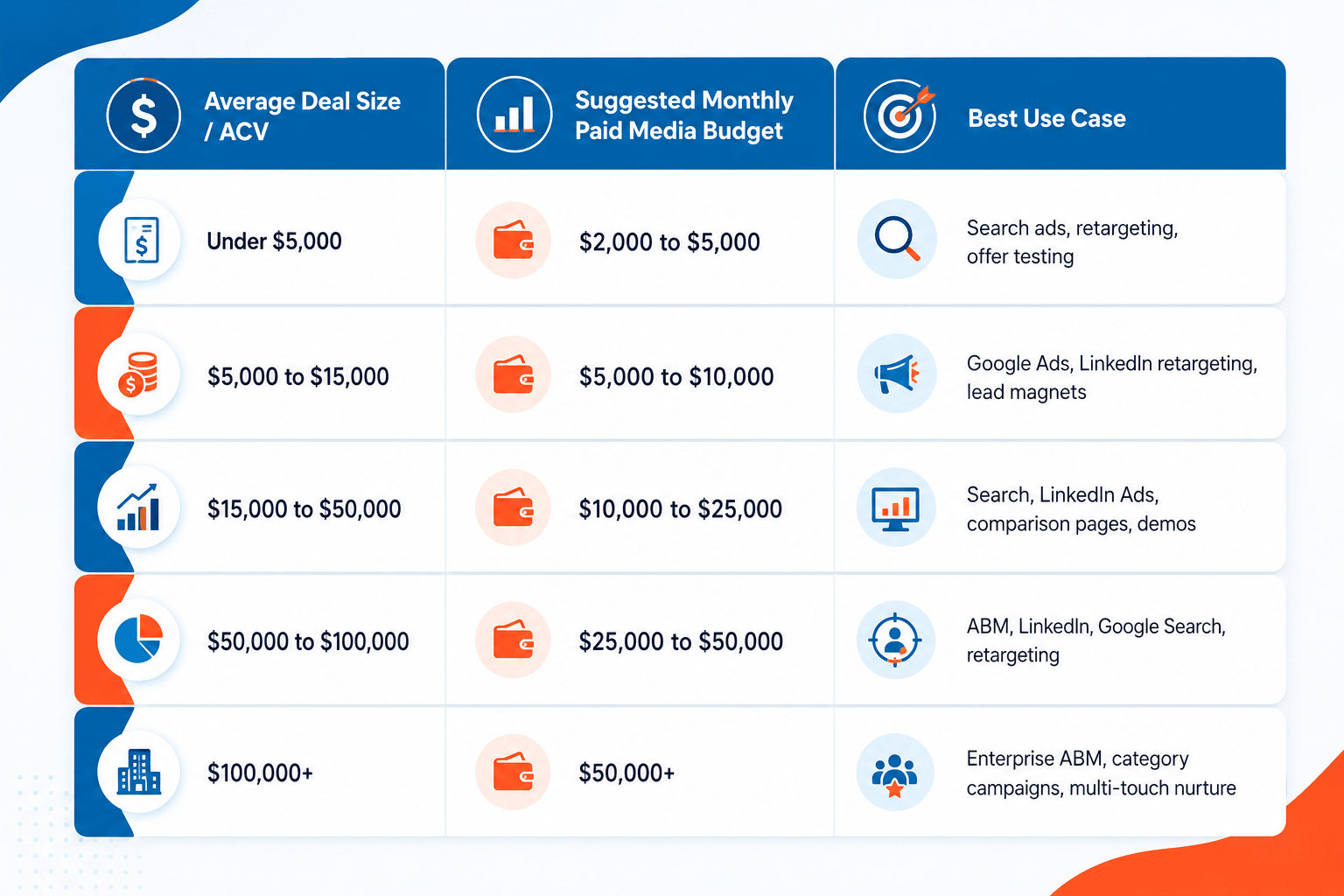
These ranges assume you already have basic conversion infrastructure in place: a clear offer, strong landing pages, CRM tracking, proper conversion events, and a sales team that can follow up quickly.
Without those pieces, increasing your B2B PPC budget will usually increase waste, not pipeline.
The most defensible way to plan paid media is to work backward from your revenue target.
Let’s say your company wants $1M in new revenue from paid media.
Your average deal size is $25,000.
That means you need:
$1,000,000 ÷ $25,000 = 40 new customers
Now, assume your sales team closes 20% of qualified opportunities.
You need:
40 customers ÷ 20% close rate = 200 opportunities
Now, assume 20% of paid leads become qualified opportunities.
You need:
200 opportunities ÷ 20% = 1,000 paid leads
If your average cost per lead is $200, your paid media budget would be:
1,000 leads × $200 = $200,000
That is your starting annual B2B PPC budget.
Some benchmarks note that B2B companies often pay around $200 per lead on average, while average B2B website conversion rates can sit around 1.8%, with stronger programs targeting 3% to 5%.
This matters because conversion rates can dramatically change your required spend. If your website converts poorly, your media budget must work harder. If your landing pages convert well, the same budget can generate more pipeline.
Paid media should not always be responsible for your entire pipeline target.
For some companies, paid media may only need to generate 20% to 30% of new pipeline, while SEO, referrals, outbound, partnerships, and events generate the rest.
For others, especially companies entering a new market or category, paid media may need to carry 40% to 60% of pipeline creation for a period of time.
A good planning question is:
What percentage of our new pipeline should reasonably come from paid media this year?
If your total pipeline target is $5M and paid media is expected to source 30%, then paid media needs to generate $1.5M in pipeline.
From there, you can calculate backward using:
Pipeline target ÷ opportunity conversion rate ÷ lead conversion rate × cost per lead
This approach is more useful than asking, “What are other companies spending?”
Benchmarks help you sanity check the number. Pipeline math tells you whether the number can actually support your revenue target.
Not all paid media channels deserve equal budget.
For most B2B companies, paid media should be split across three intent levels:
This includes Google Search Ads, competitor campaigns, category keywords, and bottom-funnel landing pages.
Examples:
These campaigns usually have lower volume but stronger buying intent.
For companies with limited budgets, this is often where to start.
This includes LinkedIn Ads, YouTube, sponsored content, and awareness campaigns targeting specific job titles, industries, or account lists.
These campaigns work well when buyers are not actively searching yet, but they match your ideal customer profile.
For higher ACV companies, demand creation is often necessary because the buying committee is small, niche, and not always searching on Google.
Retargeting helps bring back visitors who viewed key pages but did not convert.
This can include:
Retargeting is usually a smaller budget line, but it can improve conversion efficiency across the full funnel.
A $100,000 ACV company can afford to spend $10,000 to $20,000 testing a new paid media motion if the learning can lead to a repeatable pipeline.
A $5,000 ACV company may not have that flexibility.
This is where CEOs and founders need to separate testing budget from scaling budget.
A testing budget is used to answer questions:
A scaling budget is used after there is evidence.
A general thumb rule is the 70/20/10 rule, where 70% goes to proven strategies, 20% to emerging channels, and 10% to experiments.
That is a useful model for B2B paid media.
For example, if your monthly paid media budget is $20,000:
This protects your pipeline while still allowing learning.
Paid media is scalable, but not infinitely scalable.
At some point, increasing spend can lead to higher CPCs, weaker lead quality, lower conversion rates, and longer payback periods.
Paid acquisition often starts to show diminishing returns when paid media represents more than 40% of the total marketing budget.
This does not mean paid media should never exceed 40%. In a short-term pipeline push, it may. But if your company depends too heavily on paid acquisition for too long, your CAC can rise, and your growth engine becomes fragile.
That is why B2B paid media should be paired with:
Paid media creates speed. Organic and owned channels create efficiency over time.
A $1,000 monthly budget may not be enough to learn anything meaningful in competitive B2B categories. If CPCs are $20 to $80, your campaign may only generate a small number of clicks. That makes optimization slow and unreliable.
A campaign that generates 100 low-quality leads is not better than a campaign that generates 10 strong opportunities. Your B2B PPC budget should be judged by pipeline, opportunity quality, CAC, and revenue, not just CPL.
If your landing page does not clearly explain the offer, proof, use case, ICP, and next step, your ad budget will leak.
Before scaling spend, fix:
Google captures existing demand. LinkedIn often creates or influences demand. Google may convert faster, but LinkedIn can be powerful for reaching niche buying committees by title, industry, company size, and account list.
Your reporting should reflect that difference.
In B2B, speed-to-lead matters. If sales follow-up is slow, generic, or disconnected from the campaign message, paid media performance will suffer.
The campaign does not end at the form fill. It ends when revenue is closed.
So, How Much Should Your B2B Company Spend on Paid Media?
Here is the practical answer:
Most B2B companies should allocate 20% to 35% of their total marketing budget to paid media, with the exact number based on deal size, growth stage, sales cycle, and pipeline targets.
As a monthly planning range:
But the best B2B PPC budget is not the biggest one. It is the one tied to revenue math.
A strong budget answers:
When those answers are clear, paid media becomes easier to defend, optimize, and scale.
A B2B PPC budget should never be built around guesswork.
For CMOs, CEOs, and founders, the goal is not to “run ads.” The goal is to build a paid media system that turns budget into qualified pipeline and revenue.
Start with your deal size. Work backward from revenue. Model the pipeline. Fund the channels that match buyer intent. Test with discipline. Scale only when the numbers prove it.
That is how B2B companies turn paid media from an expense into a growth lever.
Need help planning your B2B PPC budget?
Parkyd Digital helps B2B companies build paid media strategies tied to pipeline, revenue, and measurable growth. Book a strategy call to see how much your company should actually spend on paid media.

Book a no-pressure discovery call and see how we can get your business rank, drive traffic, generate leads, and revenue. No sales pitch. No fluff. Just clarity.
Parkyd Digital is an award-winning B2B digital marketing agency in Kitchener-Waterloo region, Canada, helping businesses grow with SEO, Paid Media, HubSpot & high-performance website design & development. We partner with brands across GTA, Canada & entire North America to drive visibility, qualified leads & measurable revenue growth.
 Kitchener
 Toronto
 Vaughan
 Mississauga
 Brampton
 London
2026 - Parkyd Digital | All Right Reserved
Privacy Policy | Terms & Conditions

Hey, we hope you learned something new!
Let the Parkyd Digital team help you to grow your business, we are just a call away.
Click here to grow your business