


Hey, we hope you learned something new!
Let the Parkyd Digital team help you to grow your business, we are just a call away.

Parkyd's free website grader makes understanding website performance easy. Learn about your page performance, security, search engine optimization (SEO), and mobile experience. Discover what makes your site strong and uncover new opportunities for the future.
Check My WebsiteExplainers

If your website traffic is increasing but your sales pipeline remains stagnant, the issue is
rarely your product or your marketing team. For most B2B organizations, the leak happens in
a place that is easy to overlook: the experience between the first click and the CRM entry.
Site speed and user experience are often treated as technical hygiene or visual polish. In
reality, they directly influence whether a qualified buyer trusts you enough to start a sales
conversation.
This article is written for Founders, CMOs, and RevOps leaders who care about pipeline
quality, not vanity metrics. The goal is simple: help you decide whether speed and UX
deserve a real place in your growth roadmap, or whether they are being used as a
convenient excuse for deeper funnel problems.
When leads slow down, B2B teams usually look in predictable places. They question
campaign performance, sales follow-up, or messaging. Speed and UX are pushed to IT or
design backlogs because they do not feel “commercial.”
That framing misses how buyers actually behave.
In B2B, your website is not a marketing asset. It is part of your sales process. Every delay,
confusing layout, or unclear next step adds friction at the exact moment a buyer is forming
an opinion.
Poor performance erodes three revenue drivers that matter to leadership:
1. The engagement threshold
Whether a prospect stays long enough to understand what you do and who you
serve.
2. The hand-raise rate
Whether visitors feel confident enough to submit a demo or consultation request.
3. Perceived lead quality
Whether decision-makers believe your company is credible and operationally sound.
Practical example:
A CIO researching cybersecurity vendors visits two sites. One loads instantly and clearly
explains how it handles compliance and risk. The other takes five seconds to load and feels
cluttered. Even if the second vendor has a strong product, the first one gets shortlisted.
Speed and UX quietly signal technical competence and maturity.
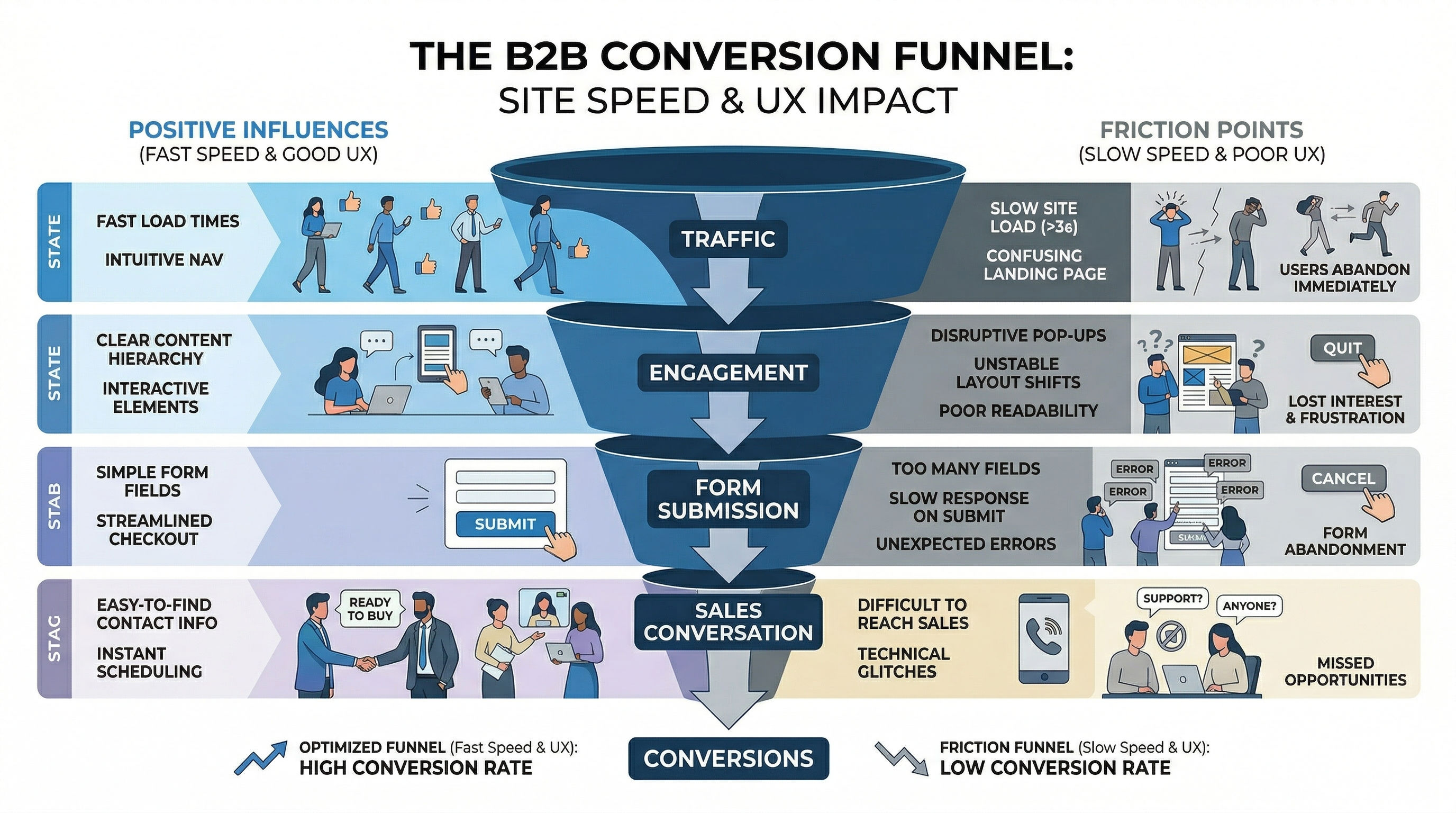
Speed is not just about impatience. It is about trust.
When a page is slow, buyers subconsciously associate that friction with how your company
operates. In high-consideration purchases, that association matters.
Research across industries consistently shows that even a one-second delay reduces
conversions. In B2B, the impact compounds because every conversion represents a high-
value opportunity.
● Pages loading within 2–3 seconds tend to capture the highest intent.
● Beyond that, form completions and demo requests begin to drop sharply.
● Slow pages also reduce the effectiveness of paid traffic by wasting clicks you already
paid for.
Practical example:
A SaaS company spending $20,000 per month on paid search sees a 2 percent landing
page conversion rate. After improving page load time from five seconds to two seconds, the
conversion rate increases to 3 percent. That single change produces 50 percent more leads
without increasing ad spend. This is a direct illustration of the site speed impact on
conversion in a B2B context.
Engine
If speed determines whether a buyer stays, UX determines whether they act.
In B2B, UX is not about visual trends. It is about reducing mental effort for people who are
busy, skeptical, and risk-averse.
A qualified buyer should understand three things within seconds:
● Who this is for
● What problem it solves
● What to do next
Anything that slows this understanding reduces lead generation.
Practical example:
A logistics firm replaces a long “Contact Us” form with a simple three-field “Get a Quote”
form and a clear link to pricing. By lowering the effort required to engage, qualified inquiries
increase by over 20 percent. The offer did not change. The experience did.
A cluttered or outdated interface signals stagnation. Clear navigation and logical structure
signal confidence and focus.
Practical example:
An enterprise HR software company restructures its navigation around industries instead of
features. A healthcare VP can now find relevant compliance information in one click. Time
on site increases, and sales reports that inbound leads are more informed and easier to
qualify.
This is the UX impact on lead generation in practice. It shortens the path from curiosity to
conversation.
If you are unsure whether speed and UX are hurting performance, your analytics already
contain clues.
Practical example:
A manufacturing consultancy notices that most mobile visitors leave within ten seconds. A
UX review reveals that a case study PDF takes over fifteen seconds to open on mobile
networks. After replacing it with a fast-loading web page, mobile lead submissions increase
within weeks.
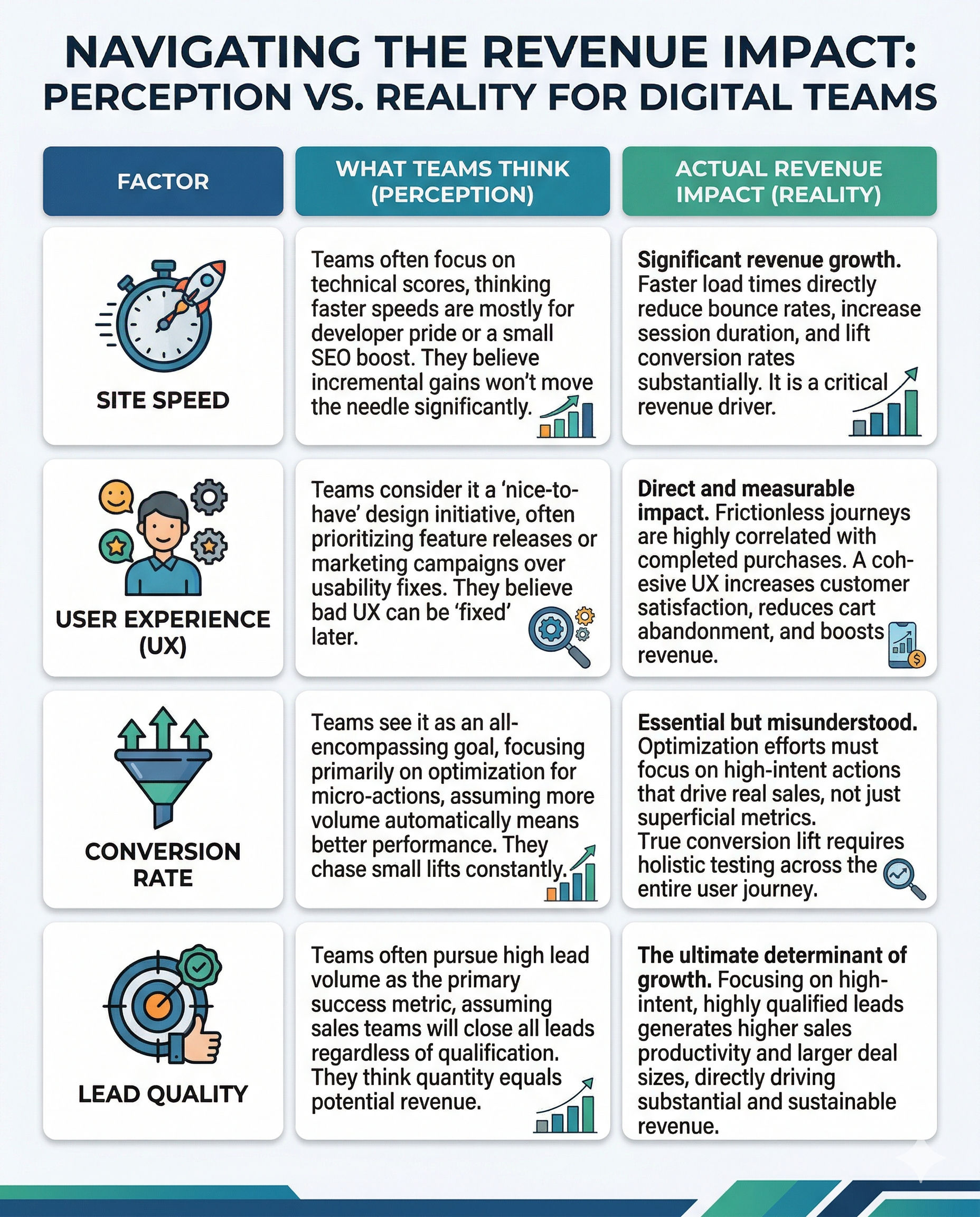
Speed and UX investments deliver the most ROI when:
● You have steady traffic but flat or declining lead volume.
● Your cost per lead keeps rising despite stable ad performance.
● You operate in a competitive market where first impressions matter.
● Sales reports that inbound leads feel unqualified or confused.
They matter less when traffic itself is the bottleneck or when messaging and positioning are
fundamentally unclear. In those cases, optimization should follow strategy, not replace it.
Asset
A proper B2B website audit does not obsess over scores. It focuses on outcomes.
The right question is not “How fast is our site?”
It is “How many qualified buyers successfully move from interest to conversation?”
This requires looking at:
● Conversion paths, not just pages
● Form behavior, not just submissions
● Assisted conversions, not just last-click attribution
At Parkyd Digital, we help B2B teams treat speed and UX as revenue levers, not IT
checkboxes. As a performance-focused B2B website agency, we audit how real buyers
move through your site and identify where friction is costing you pipeline.
If your website feels more like a brochure than a sales tool, a focused review can surface the
highest-impact fixes quickly.

Book a no-pressure discovery call and see how we can get your business rank, drive traffic, generate leads, and revenue. No sales pitch. No fluff. Just clarity.
Parkyd Digital is an award-winning B2B digital marketing agency in Kitchener-Waterloo region, Canada, helping businesses grow with SEO, Paid Media, HubSpot & high-performance website design & development. We partner with brands across GTA, Canada & entire North America to drive visibility, qualified leads & measurable revenue growth.
 Kitchener
 Toronto
 Vaughan
 Mississauga
 Brampton
 London
2026 - Parkyd Digital | All Right Reserved
Privacy Policy | Terms & Conditions

Hey, we hope you learned something new!
Let the Parkyd Digital team help you to grow your business, we are just a call away.
Click here to grow your business