


Hey, we hope you learned something new!
Let the Parkyd Digital team help you to grow your business, we are just a call away.

Parkyd's free website grader makes understanding website performance easy. Learn about your page performance, security, search engine optimization (SEO), and mobile experience. Discover what makes your site strong and uncover new opportunities for the future.
Check My WebsitePlaybooks

B2B SEO works best when it stops chasing traffic for the sake of traffic.
That sounds obvious, but a lot of companies still build search strategies around volume, impressions, and broad informational content that never gets close to pipeline. They publish blog after blog, rankings move a little, traffic goes up a little, and then they ask the real question:
That is where a real B2B SEO strategy looks different.
In B2B, search is not just a traffic channel. It is a trust channel, a research channel, and often the first serious touchpoint in a longer buying journey. Your future customer may discover you through a how-to guide, come back through a comparison page, review a case study, and only convert after visiting a service page weeks later.
So the goal is not to rank for everything. The goal is to show up at the right moments, for the right searches, with the right page.
SEO for B2B companies is different from SEO for ecommerce, news, or publisher sites because the buying motion is different.
Your customer is usually not making an instant purchase. There are multiple stakeholders, longer evaluation windows, more risk, and higher expectations. That means your SEO strategy has to do more than attract attention. It has to support education, validation, trust-building, and conversion.
A good B2B SEO strategy usually does four things well:
It targets high-intent search terms, not just high-volume ones.
It connects content to business outcomes, not just rankings.
It uses internal linking to move readers toward commercial pages.
It measures success with pipeline signals, not traffic alone.
Google’s SEO Starter Guide and link best practices support this kind of structure: clear site organization, helpful content, descriptive anchors, and crawlable links all make it easier for both users and search engines to understand what matters on your site. (Google for Developers)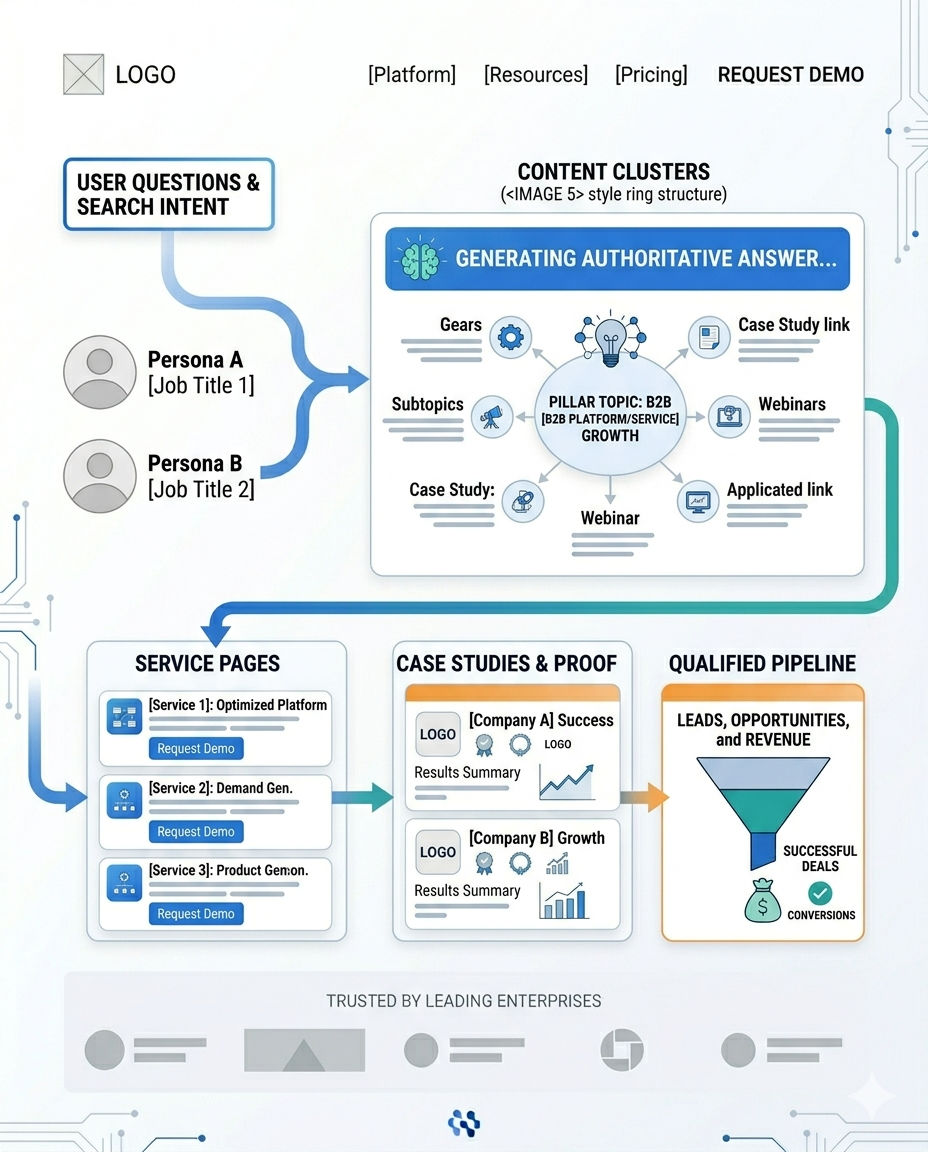
A lot of weak SEO strategies begin with a spreadsheet of keywords and monthly volume. That is not enough for B2B.
You need to know what the searcher is trying to do.
Are they trying to understand a problem?
That is where intent matters more than raw volume.
A high-intent keyword might get fewer searches, but it often attracts a much better visitor. Someone searching for “b2b seo agency” or “technical seo audit for saas website” is usually much closer to action than someone searching for “what is seo.”
A practical way to organize B2B keywords is by four intent buckets:
These reflect a pain point or operational challenge.
Example: “why inbound leads dropped after website redesign”
These show that the buyer understands the solution category.
Example: “b2b seo services”
These are strong mid-to-late stage searches.
Example: “seo agency vs in-house seo team”
These help qualify the buyer faster.
Example: “seo for b2b saas companies” or “seo for manufacturing companies”
This is where many B2B companies miss the opportunity. They publish broad educational content but do not build enough pages for category, comparison, and service intent.
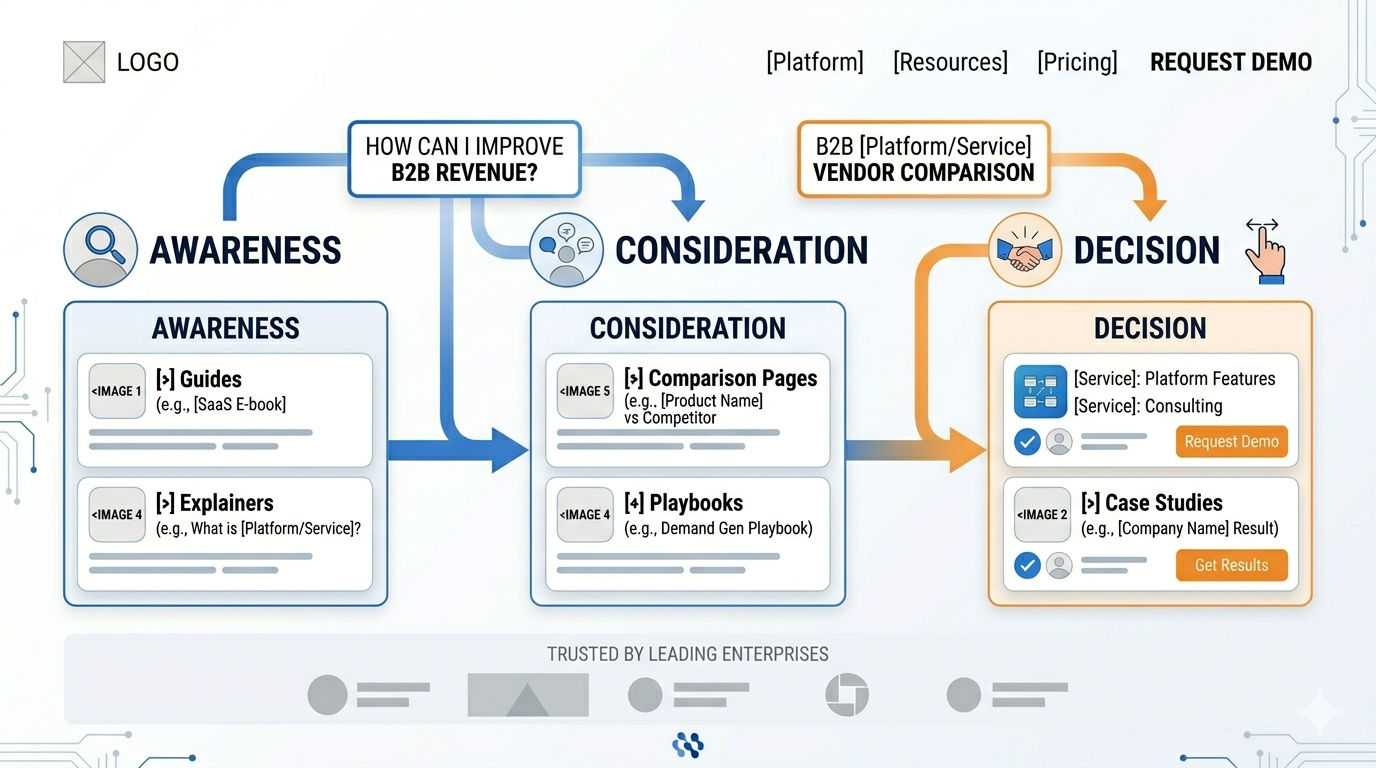
A strong B2B SEO strategy does not treat all content the same. Different pages serve different jobs.
At the awareness stage, your content should help people understand a problem or opportunity. This is where explainers, frameworks, and practical guides work well.
At the consideration stage, the reader is evaluating approaches. This is where playbooks, checklists, comparison articles, and deeper strategy posts become important.
At the decision stage, your service pages, case studies, audit pages, and proof-oriented assets matter most.
That means your site should not be a disconnected library of posts. It should feel more like a guided path.
For example, someone might land on a blog about technical SEO issues after a redesign. From there, they should be able to move naturally to a technical SEO audit page, then to a case study, then to a consultation page. If those bridges do not exist, the traffic often stalls at the blog layer.
Google’s documentation on crawlable links and internal linking supports this directly: links help Google discover pages and understand relevance, and descriptive anchor text helps people and search engines make sense of the destination. (Google for Developers)
In B2B SEO, service pages do most of the commercial heavy lifting.
These are not throwaway pages that exist only because every agency site needs them. They are often the pages with the strongest chance of attracting bottom-of-funnel traffic.
A weak service page usually has vague copy, generic promises, little differentiation, and no real proof.
A strong one answers four things quickly:
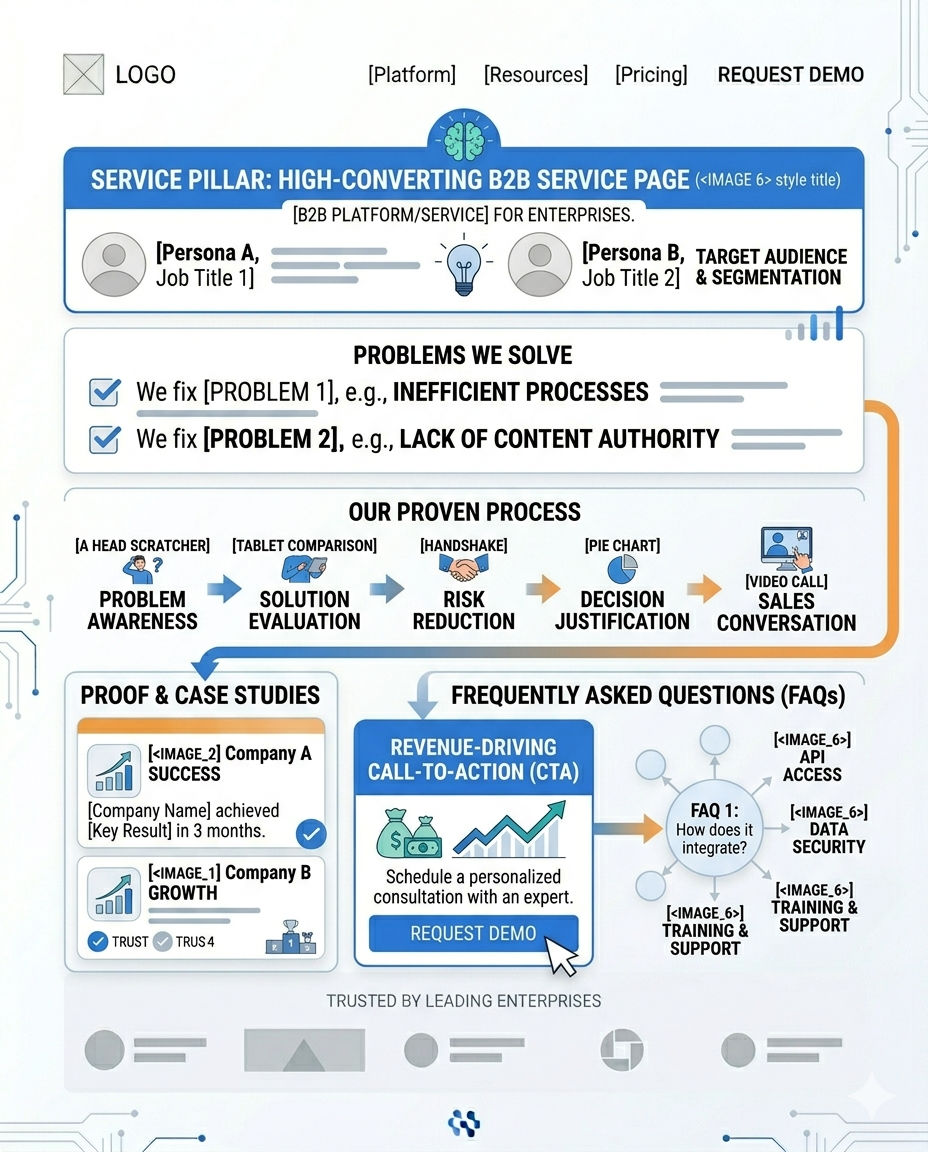
A practical example: if you offer B2B SEO services, the page should not only define the service. It should speak to the real situations that bring buyers there, such as plateauing pipeline, poor lead quality from organic traffic, weak rankings on service pages, or content that attracts readers but not opportunities.
That is also where examples matter. Readers stay longer when the content feels like it came from real client situations rather than a generic SEO template.
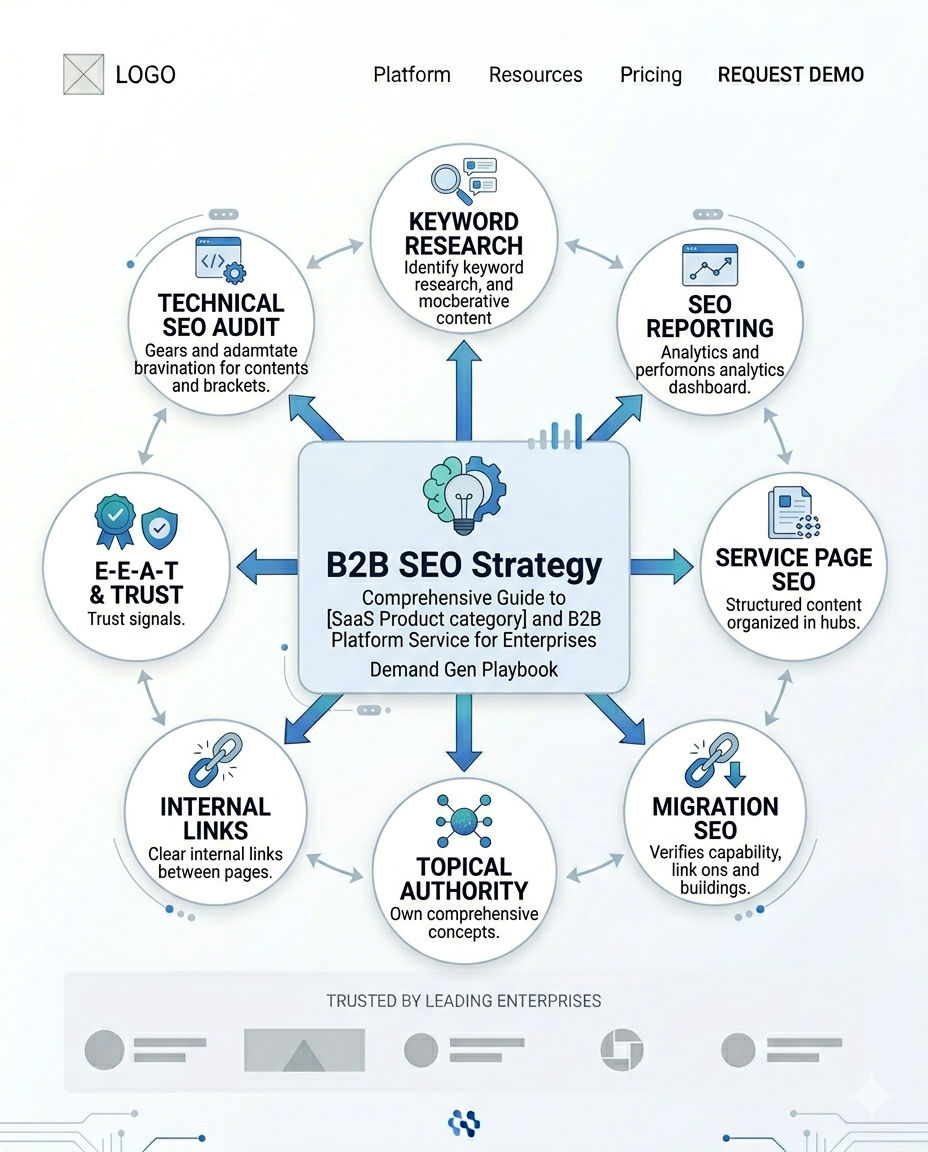
One blog post rarely wins a category by itself.
If you want to rank well for a core term like “b2b seo strategy,” you usually need a broader topical footprint around it. That means one pillar page supported by related pages that cover connected subtopics in more depth.
For this topic, a sensible cluster might include:
This structure helps users navigate the topic more completely, and it helps search engines understand the breadth and depth of your expertise. Google’s starter guide, crawling documentation, and link architecture guidance all support clear site structure and internal pathways between related pages. (Google for Developers)
Many B2B teams think of strategy and technical SEO as separate conversations. In practice, they are tightly connected.
You can publish the right pages and still underperform if search engines struggle to crawl, render, or index them properly.
Common technical issues that hurt B2B SEO include:
Google’s Search Essentials, crawling and indexing documentation, and JavaScript SEO guidance all reinforce the same principle: if Google cannot properly access, parse, or understand your content, your visibility suffers. Google also notes that dynamic rendering is a workaround, not a preferred baseline solution. (Google for Developers)
That is why technical SEO should not sit in a separate bucket. It should be part of the playbook from the start.
This is one of the biggest mindset shifts in B2B SEO.
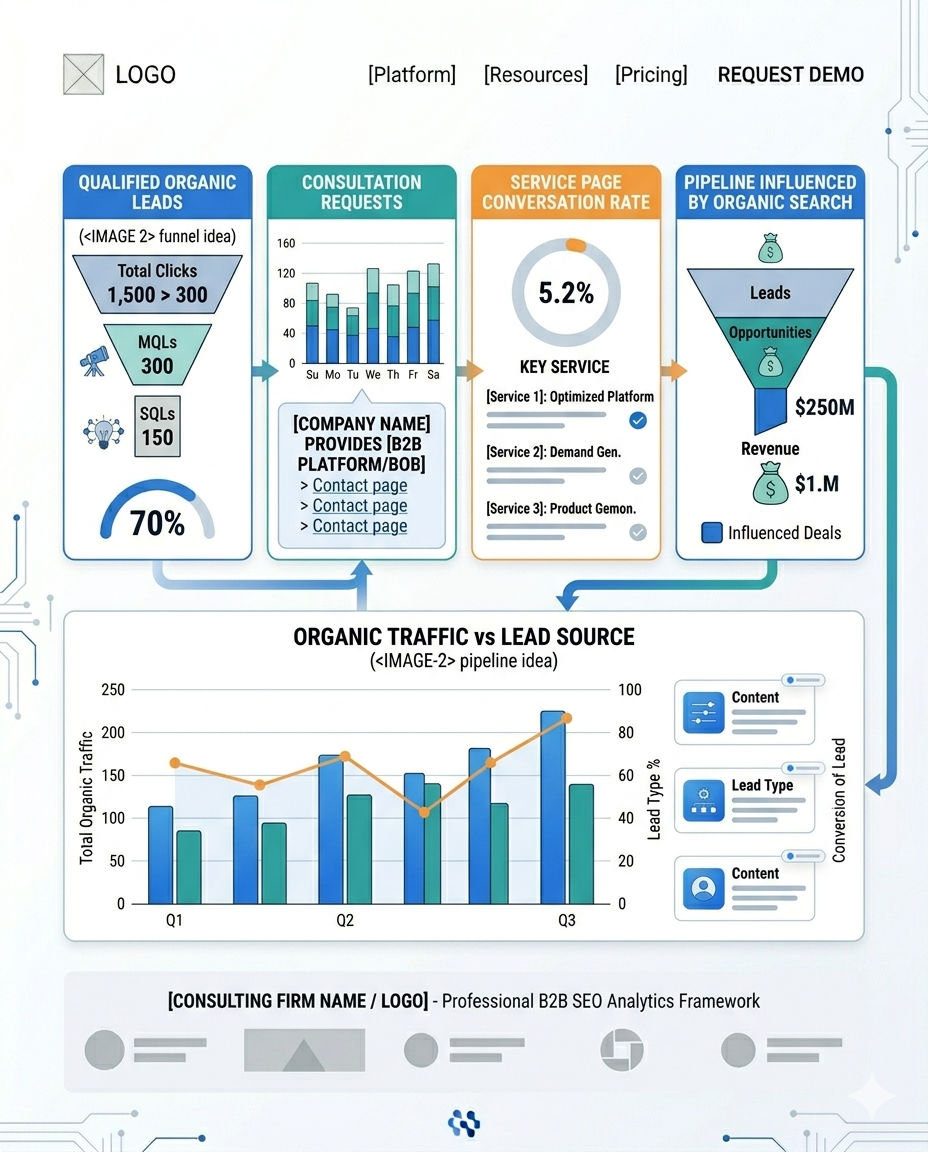
Traffic matters, but by itself it is a weak metric. A better question is whether search is helping you generate qualified demand.
For most B2B teams, stronger SEO reporting includes things like:
That is why CRM visibility matters. If your content team celebrates traffic growth while sales sees no improvement in lead quality, the strategy is incomplete.
A real B2B SEO strategy should connect rankings and traffic to business outcomes.
Some companies can build this in-house. Others need help sooner than they think.
A B2B SEO agency becomes valuable when the challenge is no longer just publishing content. It is when the company needs strategy, technical depth, content planning, internal linking, measurement, and conversion logic working together.
That is especially true when:
The right partner should not just talk about rankings. They should be able to explain how they will help you attract better-fit visitors, improve the search-to-conversion journey, and measure contribution to revenue.
A few patterns show up again and again.
One is over-investing in top-of-funnel definitions while under-investing in service, comparison, and decision-stage pages.
Another is treating every blog post as a standalone asset instead of part of a cluster.
Another is publishing AI-assisted content with no real insight added. Google’s guidance is clear that AI can be used responsibly, but content that is scaled without adding original value can create quality and spam risks. (Google for Developers)
And one of the biggest mistakes is not revisiting content after publication. Search behavior changes, product positioning changes, and supporting pages evolve. A strong B2B SEO strategy includes refresh cycles, not just new production.
The sites that perform best in modern search usually do not feel over-optimized. They feel clear, useful, and specific.
They answer the actual question.
They guide the reader to the next step.
They give enough detail to build trust.
They connect educational content to commercial pages naturally.
That is also what increases the likelihood of being surfaced in AI-powered search experiences. Google’s current guidance for AI features emphasizes useful content, good page experience, and making it easy for systems to understand the page. Structured data can help search engines understand content, but it does not guarantee enhanced visibility. (Google for Developers)
A good B2B SEO strategy is not a traffic plan.
It is a lead-generation system built around intent, trust, clarity, and conversion.
When your keyword targeting is sharper, your site structure is cleaner, your internal linking is stronger, and your content reflects the real buying journey, search starts doing what B2B teams actually need it to do: bring in better opportunities.
If your current SEO effort is generating activity but not enough qualified leads, the problem may not be effort. It may be strategy.
Parkyd Digital helps B2B companies build SEO strategies that go beyond rankings. We help uncover high-intent keyword gaps, strengthen service pages, improve search-to-conversion pathways, and connect SEO work to pipeline outcomes.
If your site is attracting visitors but not enough right-fit leads, this is usually the best place to start.

Book a no-pressure discovery call and see how we can get your business rank, drive traffic, generate leads, and revenue. No sales pitch. No fluff. Just clarity.
Parkyd Digital is an award-winning B2B digital marketing agency in Kitchener-Waterloo region, Canada, helping businesses grow with SEO, Paid Media, HubSpot & high-performance website design & development. We partner with brands across GTA, Canada & entire North America to drive visibility, qualified leads & measurable revenue growth.
 Kitchener
 Toronto
 Vaughan
 Mississauga
 Brampton
 London
2026 - Parkyd Digital | All Right Reserved
Privacy Policy | Terms & Conditions

Hey, we hope you learned something new!
Let the Parkyd Digital team help you to grow your business, we are just a call away.
Click here to grow your business