

Hey, we hope you learned something new!
Let the Parkyd Digital team help you to grow your business, we are just a call away.

Parkyd's free website grader makes understanding website performance easy. Learn about your page performance, security, search engine optimization (SEO), and mobile experience. Discover what makes your site strong and uncover new opportunities for the future.
Check My WebsiteGuides

The right SaaS SEO agency should not focus only on rankings, impressions, or traffic volume. It should help your B2B SaaS company attract the right buyers, create bottom-of-the-funnel pages, improve conversion paths, and connect organic search performance to qualified leads, demo requests, sales opportunities, and pipeline inside your CRM.
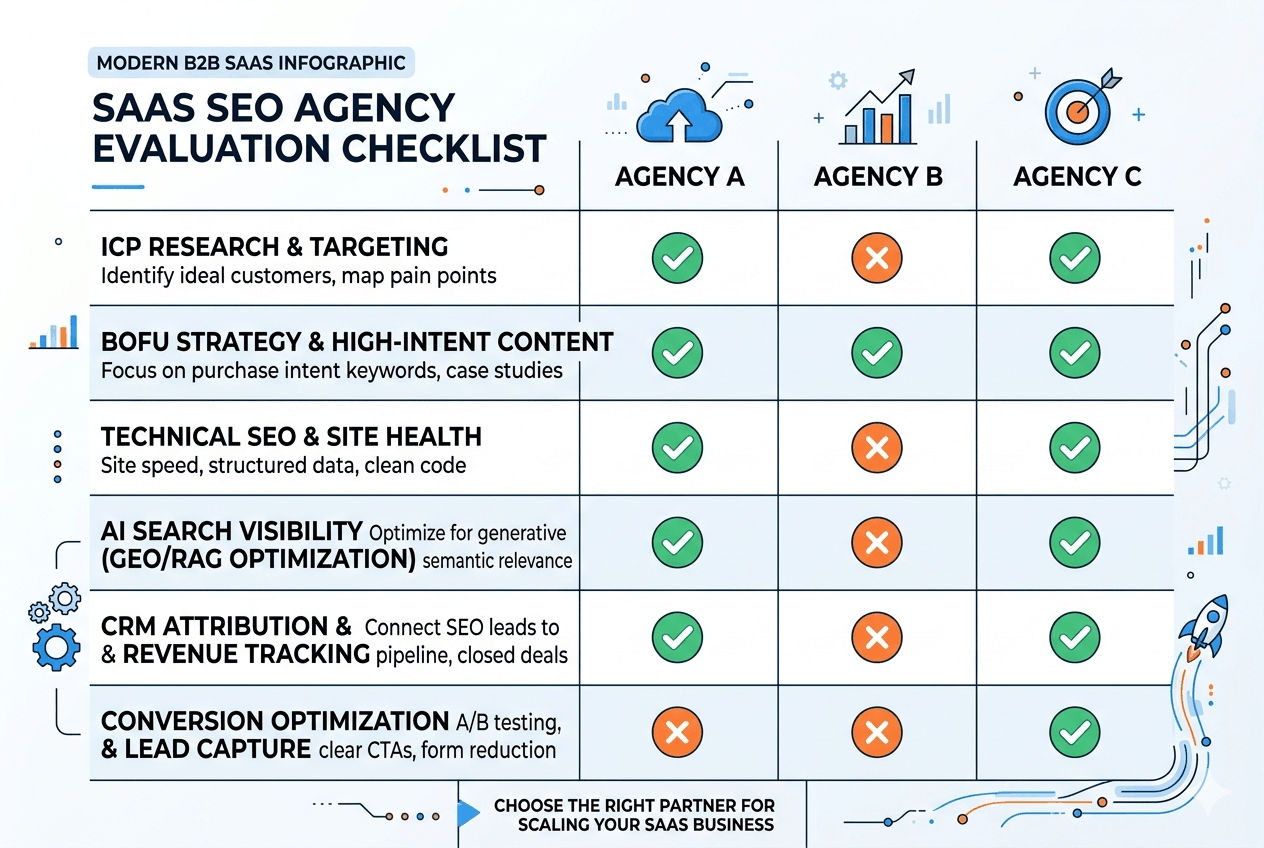
Before hiring an agency, look for proof that they understand SaaS buying journeys, high-intent keyword mapping, BOFU content, technical SEO, AI search visibility, HubSpot or CRM attribution, and conversion rate optimization.
Gartner reports that 75% of B2B buyers prefer a rep-free sales experience, which means SaaS buyers are often researching, comparing, and shortlisting vendors before they ever speak with sales.
The best partner is not the agency that promises the most blog posts. It is the one that can help turn search demand into measurable revenue opportunities.
Organic traffic only matters if it reaches people who can become customers.
Many SaaS companies invest in SEO and see traffic increase, but qualified leads and demo requests stay flat. This usually happens when the strategy is built around broad informational keywords instead of commercial-intent searches used by real buyers.
For a B2B SaaS company, the goal is not just to rank for more keywords. The goal is to appear when buyers are comparing solutions, validating vendors, checking integrations, reviewing pricing, or preparing to speak with sales.
That is why a SaaS SEO agency should be evaluated on its ability to support qualified lead generation and demo generation, not just content production.
A strong SaaS SEO strategy should help answer questions like:
Which keywords attract your ideal customer profile?
Which pages influence demo requests?
Which organic landing pages create sales opportunities?
Which content supports longer B2B buying cycles?
Which pages should connect to HubSpot, Salesforce, or another CRM for attribution?
Which topics should also be visible in AI search tools like ChatGPT, Gemini, Perplexity, and Google AI Overviews?
If an agency cannot connect SEO activity to pipeline, it may be optimizing for visibility without improving business outcomes.
SaaS SEO is different because SaaS buyers rarely make quick buying decisions.
Most B2B SaaS purchases involve multiple stakeholders. The end user may search for features. A department head may search for use cases. A technical buyer may search for integrations. A finance leader may search for pricing, return on investment, or alternatives.
That means SaaS SEO needs more than generic blog content.
A strong SaaS SEO program usually includes:
Product-led keyword research
ICP and persona mapping
Use case pages
Industry pages
Alternative pages
Comparison pages
Integration pages
Pricing-support content
Technical SEO
Conversion-focused landing pages
CRM and revenue attribution
AI search visibility optimization
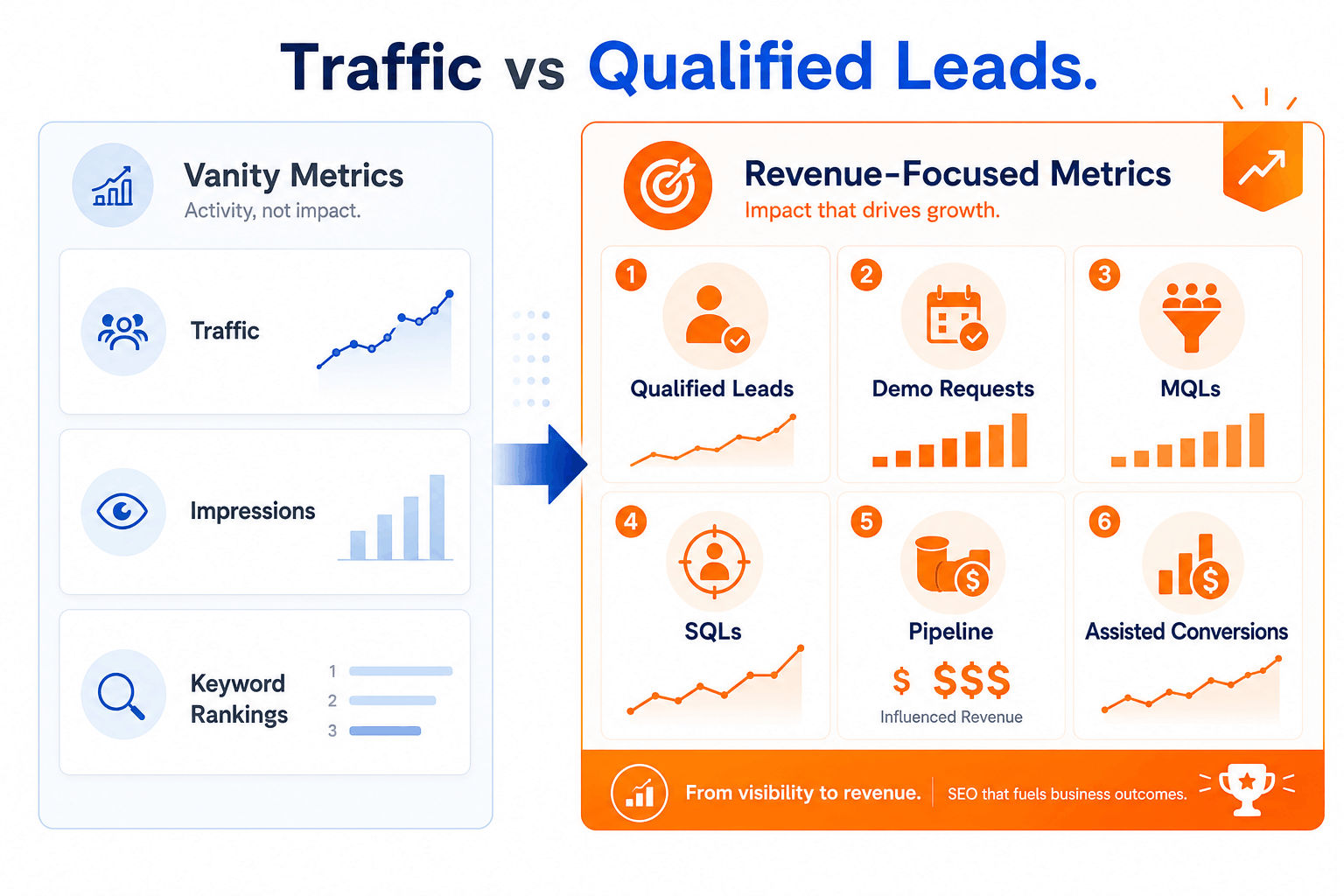
Traditional SEO often focuses on traffic growth. SaaS SEO should focus on visibility that supports qualified leads, demo requests, trials, product signups, pipeline, and revenue influence.
A SaaS SEO agency can support qualified lead generation by building a search strategy around high-intent buyer behavior.
Instead of starting with a large keyword list, the agency should first understand your product, ICP, sales cycle, average contract value, competitors, qualification criteria, and CRM setup.
From there, the agency should map SEO opportunities by funnel stage.
The highest business impact usually comes from BOFU assets such as:
Competitor alternative pages for buyers who are considering switching
Comparison pages for buyers evaluating two or more vendors
Use case pages for specific pain points, teams, or industries
Integration pages for buyers validating technical fit
Pricing and ROI pages for buyers preparing internal approval
Best software pages when they are genuinely useful, balanced, and supported by clear evaluation criteria
These pages may not always have the highest search volume, but they often attract buyers with stronger intent.
That is why the best SaaS SEO agency is not just a content vendor. It should act like a search-led demand generation partner.
When evaluating a SaaS SEO agency, look for capabilities that directly connect to qualified pipeline.
If an agency only talks about blogs, backlinks, and traffic, it may not be the right partner for a SaaS company that needs qualified opportunities.
_aGtxXUnDz.png)
There is no single best SaaS SEO agency for every company. The right fit depends on your stage, budget, market, internal team, sales cycle, and whether you need SEO only or a broader growth system.
Here are some SaaS and B2B SEO agencies worth comparing during your evaluation:
This list is not a ranking. It is a starting point for comparison.
When shortlisting agencies, compare them based on:
SaaS experience
Proof of pipeline impact
CRM and attribution capabilities
Technical SEO depth
BOFU content examples
AI search visibility approach
Understanding of your ICP
Ability to improve conversion paths
Reporting transparency
Fit with your internal team
The best agency is not the one with the biggest name. It is the one that understands your market, your product, your buyers, and your revenue goals.
Before signing a contract, ask questions that reveal whether the agency can support qualified lead generation and demo generation.
How do you identify keywords that are likely to generate qualified leads or demo requests?
How do you separate informational intent from commercial intent?
How do you decide which BOFU pages we need first?
How do you approach competitor comparison and alternative pages?
How do you map SEO strategy to our ICP and sales cycle?
What types of SaaS landing pages do you recommend for our product?
How do you create content that supports users, influencers, and decision-makers?
How do you make content useful enough to rank and convert?
How do you update existing content that gets traffic but no leads?
How do you structure content for AI search visibility?
What technical issues do you check before starting content?
How do you audit indexation and crawlability?
How do you improve internal linking for SaaS websites?
How do you handle schema and structured data?
How do you prioritize technical fixes by business impact?
How will you report qualified leads from organic traffic?
How will you report demo requests from organic traffic?
Can you connect organic landing pages to HubSpot or Salesforce?
Will we see MQLs, SQLs, opportunities, and pipeline from SEO?
How do you report assisted conversions?
A strong agency should be able to answer these questions clearly. If the answers sound vague, the strategy may not be mature enough for revenue-focused SaaS SEO.
_eLDNFJmwQ.png)
Not every SEO agency is built for SaaS.
Watch for these red flags.
No credible agency can guarantee exact rankings, a fixed number of leads, or a fixed number of demos. Search algorithms, competition, buyer behavior, website quality, and sales cycles all change.
A good agency can explain its process, forecasting logic, and measurement plan. It should not promise outcomes it cannot fully control.
If the pitch is mostly “we publish 12 blogs per month,” be careful.
SaaS SEO is not about publishing more content. It is about publishing the right pages for the right buyers at the right stage of the journey.
If the agency does not ask about your target accounts, deal size, sales cycle, product positioning, competitors, and qualification criteria, it cannot build a lead-focused strategy.
If the agency only reports traffic, impressions, and keyword rankings, you may struggle to prove business impact.
For SaaS, reporting should connect SEO to leads, demos, opportunities, and pipeline wherever tracking allows.
AI visibility is important, but it should not be sold as a shortcut.
Strong AI search visibility still depends on helpful content, clear structure, technical accessibility, topical authority, trustworthy sources, and strong brand signals.
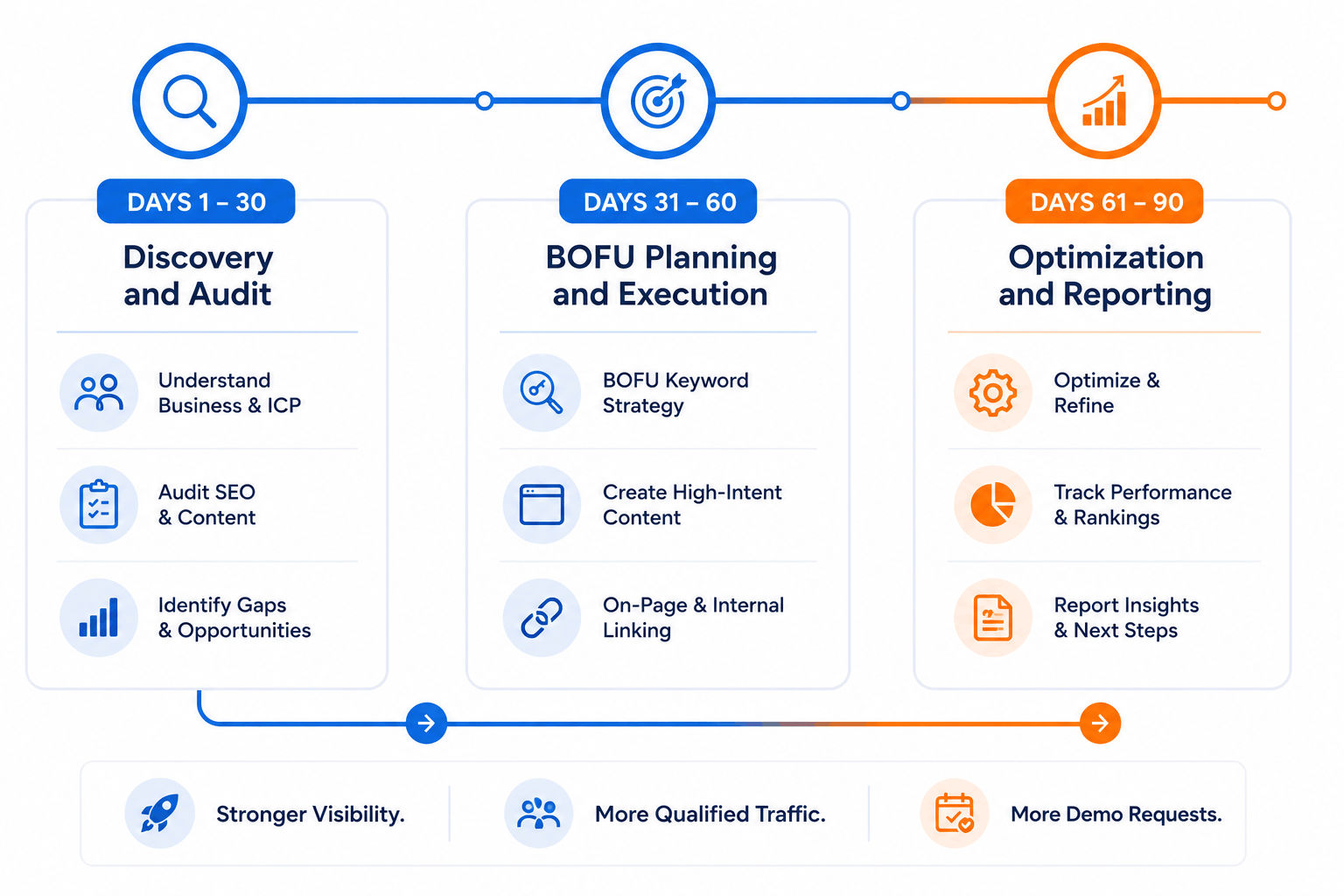
The first 90 days should balance strategy, technical fixes, content planning, conversion improvements, and tracking setup.
The first month should focus on understanding the business and fixing measurement gaps.
Key activities should include:
ICP and product discovery
Competitor review
Keyword and content gap analysis
Technical SEO audit
Existing content audit
Conversion path review
HubSpot or CRM tracking review
Search Console and GA4 review
Priority roadmap creation
The goal is to identify where SEO can influence qualified lead generation fastest.
The second month should focus on high-intent pages and quick conversion improvements.
Key activities may include:
Updating existing high-traffic pages with better CTAs
Creating BOFU content briefs
Planning comparison and alternative pages
Creating use case or industry page outlines
Improving internal links to service, demo, or product pages
Fixing technical issues that affect ranking or conversion
Setting up reporting dashboards
The goal is to move from audit to execution.
The third month should focus on publishing, monitoring, and improving.
Key activities may include:
Publishing priority BOFU pages
Monitoring indexation
Reviewing early ranking movement
Tracking conversions from organic landing pages
Improving CTA placement
Reviewing form completion behavior
Reporting organic leads, demo requests, MQLs, SQLs, and pipeline where available
Finalizing the next 90-day roadmap
By the end of 90 days, you may not have full SEO compounding yet, but you should have a clear strategy, improved tracking, early execution, and a roadmap connected to business outcomes.
A revenue-focused SaaS SEO agency should report on more than rankings.
Important KPIs include:
Organic qualified leads
Organic demo requests
Organic form submissions
Organic MQLs
Organic SQLs
Organic-sourced pipeline
Assisted conversions from organic content
Conversion rate by landing page
Non-branded organic traffic to BOFU pages
Rankings for commercial-intent keywords
Search visibility for comparison, alternative, and use case topics
Indexed pages and technical health
AI search visibility where measurable
Traffic and impressions are still useful, but they are leading indicators. For SaaS companies, the most important question is whether organic search is helping create qualified opportunities.
Parkyd Digital is a strong fit if your B2B SaaS company wants SEO to work as part of a larger growth system.
Many SaaS companies do not need SEO in isolation. They need SEO connected with website conversion, HubSpot tracking, paid media insights, AI visibility, and revenue reporting.
Parkyd Digital helps B2B companies improve search visibility, attract qualified traffic, and convert visitors into customers through SEO, AI SEO, HubSpot, PPC, website development, and growth consulting.
This makes Parkyd Digital a practical option for SaaS companies that want:
SEO strategy connected to qualified leads
BOFU content that supports demo requests
AI search visibility
HubSpot and CRM alignment
Conversion-focused website improvements
Paid and organic insights working together
Clearer reporting around pipeline impact
If you are looking only for blog production, Parkyd may not be the best fit.
But if you want a partner that can connect search visibility with demand generation, conversion strategy, and measurable growth, Parkyd Digital should be on your shortlist.
Choosing a SaaS SEO agency is not about finding the cheapest vendor or the agency with the longest service list.
It is about choosing the partner most likely to understand your buyers and help you convert search demand into pipeline.
Before making the final decision, ask yourself:
Does this agency understand our ICP?
Can they explain how SEO will support qualified leads and demo requests?
Do they know how to build BOFU SaaS content?
Can they connect SEO performance to our CRM?
Do they understand AI search visibility without overhyping it?
Can they improve our conversion paths, not just our rankings?
Do they report on business outcomes, not just SEO activity?
Do they feel like a growth partner or a content vendor?
If the answer is yes, you may have found the right SaaS SEO partner.
If the answer is no, keep looking.
The best SaaS SEO agency is the one that can connect search visibility to real business outcomes.
That means your agency should understand your ICP, prioritize high-intent keywords, build BOFU pages, improve conversion paths, and connect organic performance to qualified leads, demo requests, and pipeline.
For B2B SaaS companies, SEO should not be treated as a traffic channel only. It should be treated as part of your demand generation and revenue system.
If your current organic strategy is bringing traffic but not qualified leads, it may be time to rethink your approach.
Parkyd Digital helps B2B and SaaS companies build SEO strategies designed for visibility, AI search discovery, qualified leads, and measurable growth.
Ready to find out where your SaaS SEO strategy is leaking qualified opportunities?
Book a SaaS SEO consultation with Parkyd Digital and get a practical roadmap for turning search demand into a pipeline.
A SaaS SEO agency helps software companies improve organic search visibility, attract qualified buyers, and convert website visitors into leads, demo requests, trials, signups, or sales opportunities. A strong SaaS SEO agency works across keyword strategy, content, technical SEO, conversion optimization, and reporting.
SaaS SEO generates qualified leads by targeting high-intent searches from buyers who are comparing solutions, researching use cases, checking integrations, or evaluating vendors. BOFU pages, comparison content, use case pages, and optimized CTAs help turn those visitors into leads or demo requests.
Ask how the agency identifies lead-ready keywords, builds BOFU content, tracks organic leads, connects SEO to HubSpot or Salesforce, improves conversion rates, and reports pipeline impact. Avoid agencies that only talk about rankings and traffic.
SaaS SEO is different because it must support longer sales cycles, multiple decision-makers, product-led education, integrations, pricing research, comparison searches, and demo generation. It requires stronger alignment between SEO, product marketing, sales, and CRM reporting.
A SaaS SEO agency should report on organic qualified leads, demo requests, MQLs, SQLs, organic-sourced pipeline, assisted conversions, landing page conversion rates, rankings for commercial-intent keywords, and technical SEO health.
Book a no-pressure discovery call and see how we can get your business rank, drive traffic, generate leads, and revenue. No sales pitch. No fluff. Just clarity.
Parkyd Digital is an award-winning B2B digital marketing agency in Kitchener-Waterloo region, Canada, helping businesses grow with SEO, Paid Media, HubSpot & high-performance website design & development. We partner with brands across GTA, Canada & entire North America to drive visibility, qualified leads & measurable revenue growth.
 Kitchener
 Toronto
 Vaughan
 Mississauga
 Brampton
 London
2026 - Parkyd Digital | All Right Reserved
Privacy Policy | Terms & Conditions

Hey, we hope you learned something new!
Let the Parkyd Digital team help you to grow your business, we are just a call away.
Click here to grow your business