


Hey, we hope you learned something new!
Let the Parkyd Digital team help you to grow your business, we are just a call away.

Parkyd's free website grader makes understanding website performance easy. Learn about your page performance, security, search engine optimization (SEO), and mobile experience. Discover what makes your site strong and uncover new opportunities for the future.
Check My WebsiteCase Study

If Google’s AI-powered search starts answering everything directly on the results page, does it still make sense to invest in SEO, or should that budget be moved elsewhere?
The concern is understandable. AI overviews are already reducing clicks on traditional listings. For teams that rely on organic traffic to support pipeline targets, this feels like a direct threat.
But the real issue is not whether SEO still works.
The real issue is whether your SEO strategy is built for how discovery now happens.
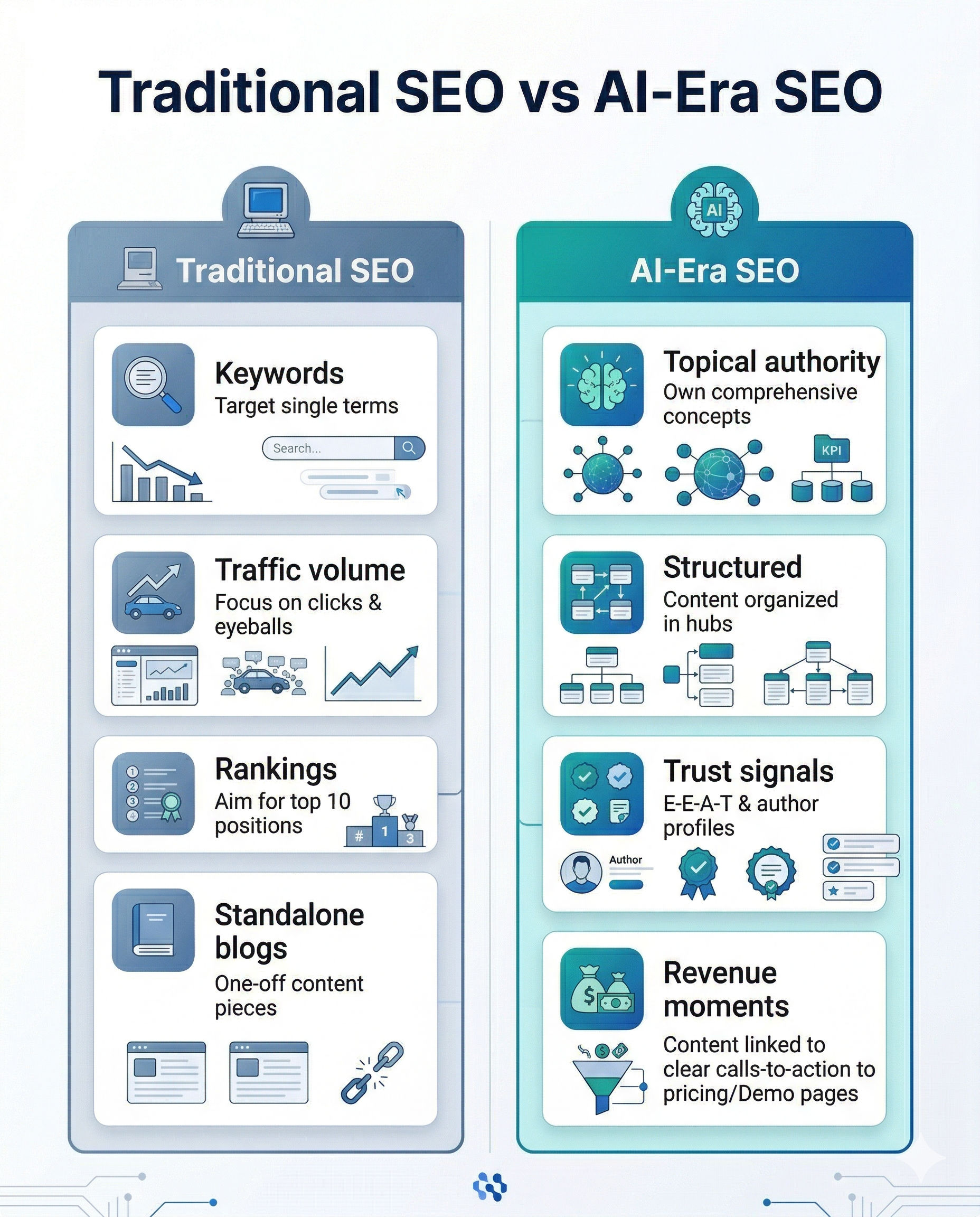
This anxiety is not theoretical. Several structural shifts are happening at the same time.
AI overviews increasingly answer questions without requiring a click. Buyers are getting comfortable with conversational, summarized answers instead of scanning ten blue links. Some publishers are seeing traffic drops when their content is used inside AI summaries without driving visits back to the site.
What most teams miss is the operational mismatch underneath.
SEO is still being run as a traffic channel, measured on rankings and sessions. Google’s AI-powered search is optimizing for answer quality and user satisfaction, not website visibility.
When those incentives diverge, classic SEO tactics naturally underperform.
For B2B companies, this is less about algorithms and more about execution.
Common patterns show up again and again.
Many teams still measure SEO success by traffic growth, not by sales-accepted pipeline or revenue influence. That makes SEO look weak the moment AI reduces top-of-funnel clicks.
Content is often produced as standalone blog posts targeting broad keywords. There is little structure, little internal linking, and no clear ownership of a topic from start to finish.
Trust signals are thin. Author expertise is vague, schema is missing or incomplete, and real-world experience is rarely made explicit.
And finally, SEO programs are heavily weighted toward informational content. Unfortunately, those are the exact queries AI overviews are most likely to answer directly.
When boards ask “Is SEO dead?”, what they are really reacting to is an SEO model that is no longer aligned with how buyers search.
AI-powered search mainly displaces content that is easy to summarize.
Think generic how-to articles, surface-level explainers, and broad definitions. These are the queries where users want quick orientation, not deep evaluation.
For B2B revenue teams, this leads to three practical realities.
First, you will get fewer cheap eyeballs. Broad informational content will see lower click-through rates. That traffic was never strongly correlated with pipeline anyway.
Second, complex buying decisions still require depth. When a buyer is evaluating vendors, integrations, security, pricing models, or implementation risk, they still click. AI overviews often act as a filter, not the final decision-maker.
Third, authority matters more than volume. AI systems increasingly surface brands that demonstrate clear expertise, consistent topical coverage, and real experience.
A simple example:
A cybersecurity SaaS may lose traffic on “what is zero trust security,” but still win clicks and pipeline on “zero trust implementation for healthcare compliance” or “zero trust vs VPN for enterprise teams.”
The old SEO game of publishing lots of mid-quality content is shrinking. The strategic game of owning decision journeys is growing.
Buyers are already using Google’s AI overviews, ChatGPT, Gemini, and other AI-driven tools to research vendors.
The goal is not to fight these systems.
The goal is to become a trusted input to them and a destination when deeper evaluation is required.
That requires changing how SEO is designed.
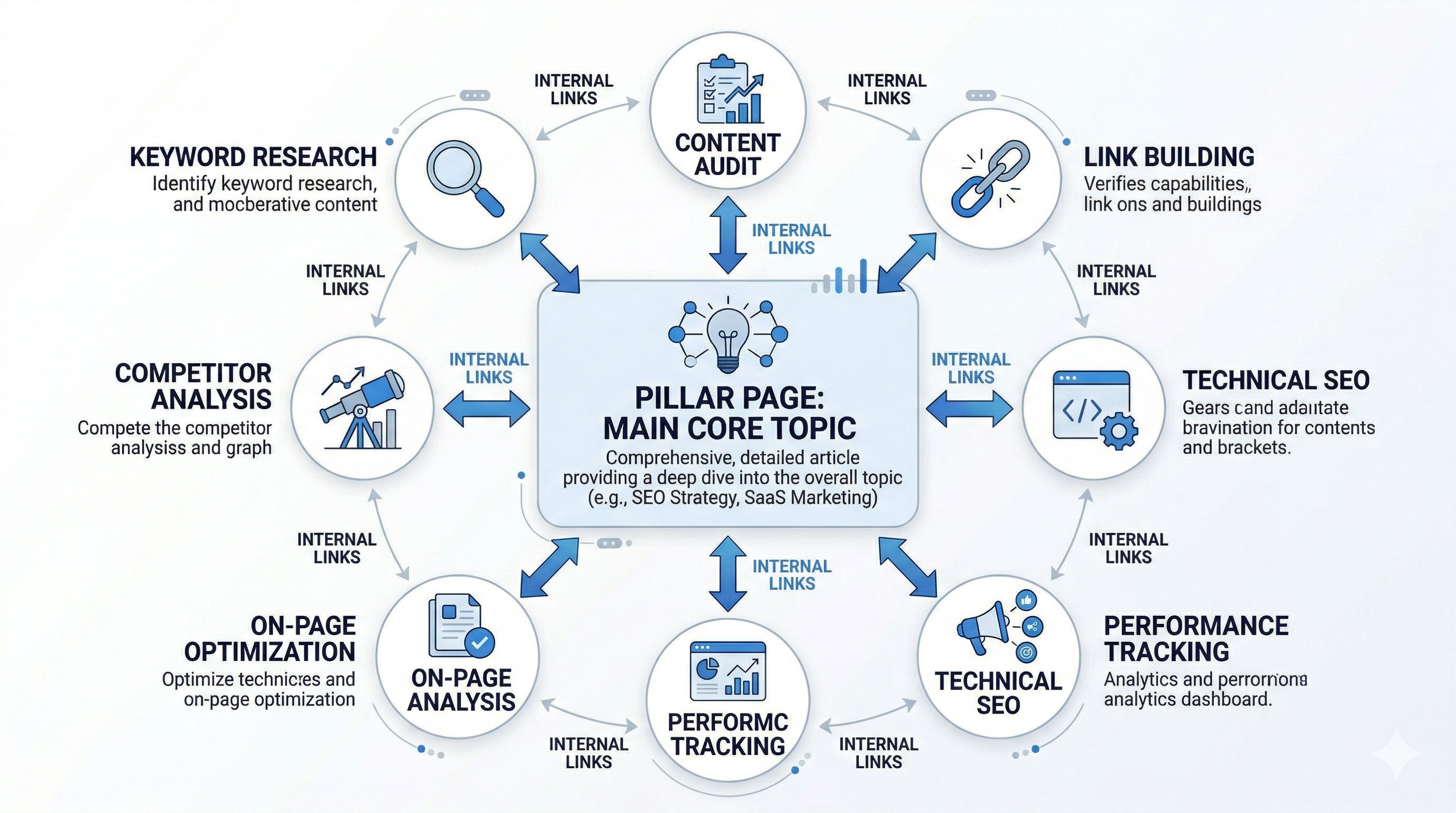
Instead of chasing hundreds of loosely related keywords, focus on depth.
Choose a small number of topics that directly map to your best deals. Build pillar pages that fully cover those topics, then support them with tightly scoped subtopics that answer specific questions buyers ask at different stages.
For example, a B2B analytics company might build a cluster around “Revenue Attribution for SaaS,” supported by pages on attribution models, CRM integration, data limitations, and executive reporting.
This structure makes it easier for AI systems to understand who you are authoritative for and when to surface your brand.
AI models consume content differently than traditional ranking systems.
That means clean information architecture, logical internal linking, and consistent terminology matter more than ever.
Structured data helps machines understand what your content represents. Author bios with real experience help establish trust. Case studies and concrete examples help AI systems classify your brand as a credible source, not generic content.
A simple example:
Two articles may explain the same concept, but the one that includes a named expert, real implementation details, and clear structure is far more likely to be cited or summarized.
SEO that survives AI is tied to moments that influence buying decisions.
These include comparison queries, implementation guides, integration details, ROI discussions, risks, and alternatives.
For instance, a HubSpot partner may see less value in ranking for “what is CRM,” but far more impact from content like “HubSpot CRM migration checklist” or “HubSpot vs Salesforce for mid-market teams.”
The KPI shifts from “How much traffic did we get?” to “How many high-intent sessions entered the sales process?”
One B2B SaaS company noticed organic traffic decline after AI overviews appeared for several educational queries.
Instead of cutting SEO spend, they analyzed which pages influenced opportunities. They found that most closed-won deals originated from solution-aware and implementation-focused content.
They consolidated dozens of thin blog posts into a small number of authoritative clusters. They added expert authorship, schema, and stronger internal linking.
Total traffic decreased.
Pipeline from organic sessions increased.
Sales cycles shortened because buyers arrived more educated.
This is the trade-off AI search introduces, and it favors teams that optimize for revenue, not vanity metrics.
Lean into modern SEO if your buyers use search heavily during vendor research, your product requires trust and depth, and you can invest in expert-led content.
Narrow or pause SEO expansion if your category is low-consideration, your team can only produce volume blogs, or you cannot connect organic activity to revenue.
In those cases, SEO should become more focused, not abandoned.
Some teams are cutting SEO the moment traffic dips without checking which pages drive pipeline.
Others are chasing AI shortcuts instead of strengthening fundamentals like authority and structure.
Many treat AI summaries as a threat rather than studying which brands and content types are being cited.
And too often, SEO and paid media remain siloed even though AI blends them into a single discovery experience.
Each of these mistakes slows learning in a landscape that is evolving quickly.
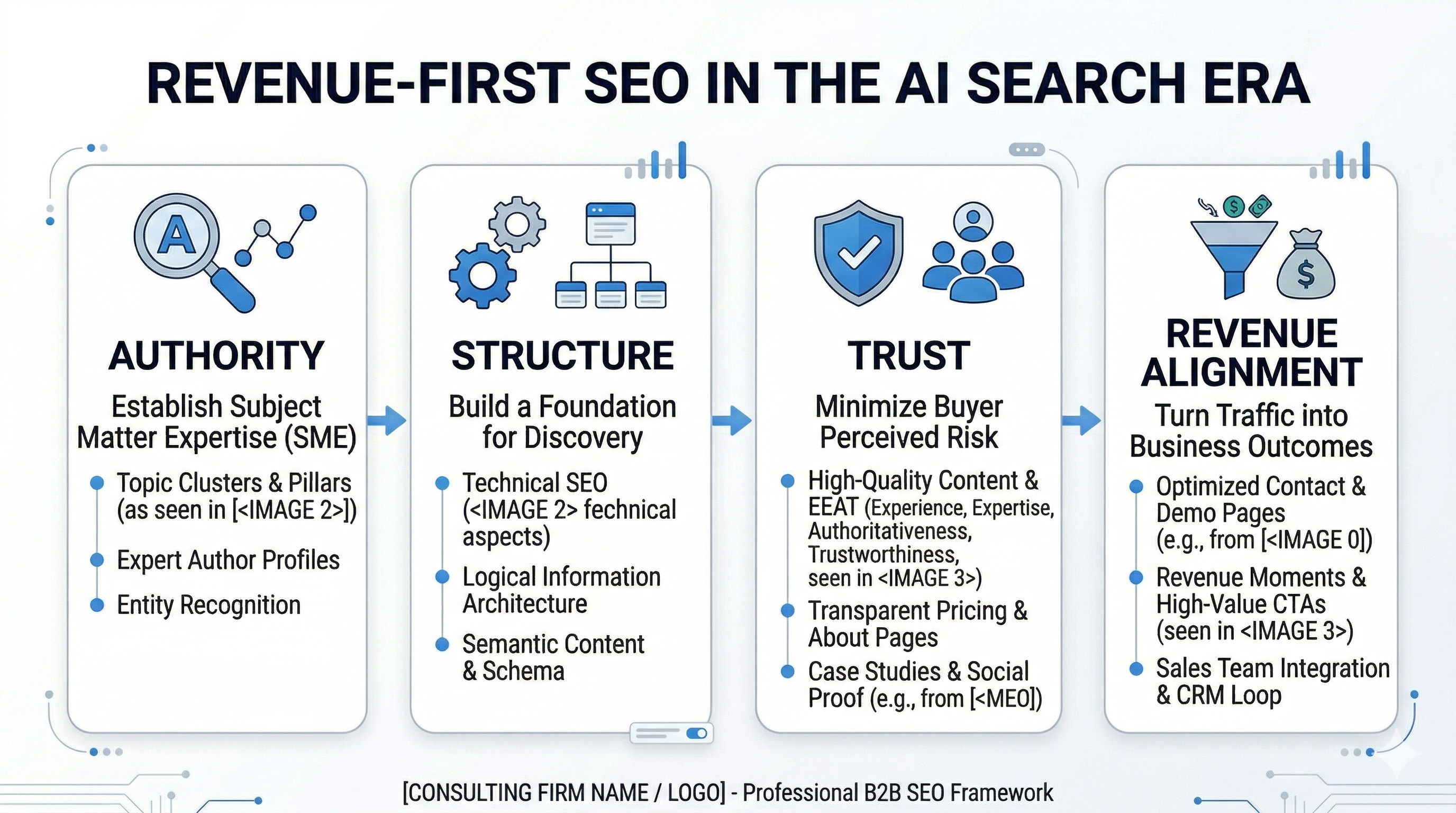
If we were advising you, we would not start with “Is SEO dead?”
We would start with a focused, AI-aware SEO audit.
That audit would map organic content to pipeline, analyze how your brand appears in AI-driven experiences, identify a small number of strategic topic clusters, and align SEO with paid media and RevOps around the same intent signals.
The goal is not to beat AI search.
The goal is to ensure your brand remains visible and trusted wherever buyers search.
If traffic reports feel confusing right now, you are not alone.
The safest move is not a full pivot. It is a focused audit designed for AI-driven discovery.
A good audit should clearly answer where you are already winning, where AI summaries are replacing clicks, and which few moves will most improve authority and pipeline in the next quarter.
Framed correctly, this is less about predicting the future of SEO and more about adapting to how buyers already behave.

Book a no-pressure discovery call and see how we can get your business rank, drive traffic, generate leads, and revenue. No sales pitch. No fluff. Just clarity.
Parkyd Digital is an award-winning B2B digital marketing agency in Kitchener-Waterloo region, Canada, helping businesses grow with SEO, Paid Media, HubSpot & high-performance website design & development. We partner with brands across GTA, Canada & entire North America to drive visibility, qualified leads & measurable revenue growth.
 Kitchener
 Toronto
 Vaughan
 Mississauga
 Brampton
 London
2026 - Parkyd Digital | All Right Reserved
Privacy Policy | Terms & Conditions

Hey, we hope you learned something new!
Let the Parkyd Digital team help you to grow your business, we are just a call away.
Click here to grow your business